
Pomerania, Poland
The name of this Polish voivodeship comes from the historic region of Pomerania, which encompasses the entire Baltic coast and its hinterland, from the Darß-Zingst Peninsula to the Bay of Gdańsk. The administrative boundaries have undergone several changes. Since coming under Polish rule in 1945, two Polish voivodeships have been established in the territory of historic Pomerania: Województwo pomorskie (Pomerania), with its capital in Gdańsk (Danzig), and Województwo zachodniopomorskie (West Pomerania), with its capital in Szczecin (Stettin).
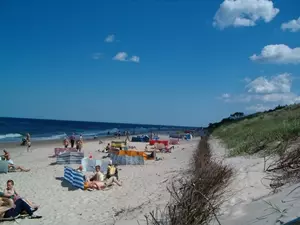 Küste bei Rowy in der Wojewodschaft Pommern
Photo: © oben: wikipedia.de/gemeinfrei; unten: wikipedia.de/Cornelius Schumacher/CC BY-SA 3.0
Küste bei Rowy in der Wojewodschaft Pommern
Photo: © oben: wikipedia.de/gemeinfrei; unten: wikipedia.de/Cornelius Schumacher/CC BY-SA 3.0
Natural environment and seaside resorts

On the western shore of the Bay of Gdańsk lie the three cities of Gdańsk (Danzig), Sopot (Zoppot), Poland’s largest seaside resort, and the port city of Gdynia (Gdingen). The 34-kilometre-long Hel Peninsula, a narrow spit, forms the northwestern boundary of the Bay of Gdańsk. It is one of the most popular excursion destinations on the Polish Baltic coast.
A straight coastline without bays stretches for more than 100 kilometres from Ustka (Stolpmünde) to the island of Wolin in the west, interrupted only by the narrow mouth of the Dziwna (Dievenow). The Baltic coast of Pomeranian Voivodeship is home to numerous seaside resorts, of which Sopot (Zoppot), along with Kołobrzeg (Kolberg), Międzyzdroje (Misdroy) and Świnoujście (Swinemünde), is among Poland’s most important.
With Gdańsk (Danzig) as its urban centre, and the spits of the Vistula Spit and Hel Peninsula, as well as the shifting dunes near Łeba in Słowiński National Park, this region offers outstanding tourist destinations.
B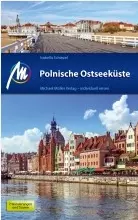 OOK RECOMMENDATION: The Polish Baltic Coast
Miles of sandy beaches, shifting dunes up to 40 metres high, breathtaking cliffs, deep-green forests and crystal-blue glacial lakes inland, traditional seaside resorts and cultural cities steeped in history… The Polish Baltic coast feels less polished than its counterpart in Germany, while cities such as Gdańsk and Szczecin fascinate with the palpable tension between tradition and modernity found everywhere: a centuries-old brick church, built to last forever, here—and just a few metres away, a hip café with a cool, laid-back design.
Across 288 information-packed pages, this book provides everything you need to explore a European region in transition independently—whether you’re a beach lover, water sports enthusiast, hiker or culture-seeker.
Schinzel, Isabella, 288 pages, EUR 16.90 (Germany), ISBN 978-3-95654-044-8
