
Glücksburg Castle
Glücksburg Castle – the origins of today’s monarchies
The Flensburg Fjord, where Glücksburg Castle is located, today forms the border between Denmark and Germany and is one of the most popular holiday destinations on the Baltic Sea in the Schleswig region. For centuries, the entire area has been a place where Germans and Danes, and German and Danish history, have met. Glücksburg Castle is the finest example of this. It lies close to the Flensburg Fjord, on its southern shore, roughly halfway between Flensburg and the fjord’s mouth on the Baltic Sea. The history of Glücksburg Castle brings together the story of the building and that of the Glücksburg ducal family, a branch of the House of Schleswig-Holstein-Sonderburg. This noble house played an important role in European history and still provides several reigning monarchs today. Members of the House of Glücksburg include King Harald V of Norway, Queen Margrethe II of Denmark, and Queen Sofia of Spain.
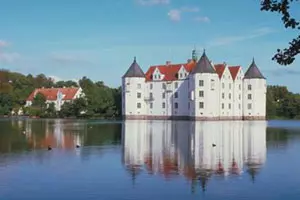 Schloss Glücksburg
Photo: © Thomas Raake/WiREG
Schloss Glücksburg
Photo: © Thomas Raake/WiREG
Glücksburg Castle – a unique museum
Construction of the castle began at the end of the 16th century on the remains of a Cistercian monastery. Over its rich and eventful history, the castle served as a residence for various ruling houses, including the Danish royal family. In 1922, the castle was placed in a foundation, and since then—after several interim stages—it has gradually been developed into a museum. The ducal family still exercises rights over the property.
Because of its extraordinary architecture, the moated castle, located on an island in the castle pond, is one of the most photographed sights in Schleswig-Holstein. Part of the castle is open to visitors. For most holidaymakers on the Baltic coast of Schleswig, a visit to Glücksburg Castle is an essential part of their itinerary. The castle is one of the most highly recommended excursions in the Schleswig region and beyond. The extensive, lovingly restored castle, with its wings and floors, offers an authentic glimpse into the history not only of the House of Glücksburg, but also of the part of European history that unfolded especially around the Baltic coast.
Weddings and baptisms are held in the romantic castle chapel. More than 400 different varieties of roses can be admired in the rose garden of the castle grounds.
Photo: Thomas Raake/WiREG
