
Metal Designer Udo Richter
It is easy to approach Udo Richter’s house. Situated near a renovated road on the main route through Pepelow, on the Salzhaff in Mecklenburg, the surroundings immediately reveal an interest in the unusual. From the outside, the old farmhouse looks as though it has been left in its natural state; inside, too, “nature” is at work.
It is less easy to get close to Richter the person. He looked at me with a hint of surprise and curiosity when I met him at an exhibition opening at the Usedom Art House in Zinnowitz and offered to write about him.
On the sunny day of my visit, the light streamed through the glass entrance door almost to the very heart of the place—the melting core of his latest work, whose creation I was able to follow. The finished casting mold bears the imprint of a seashell.
Udo Richter is happy enough to talk about himself, but deliberately takes his listener on a roundabout route. He does not expound lofty artistic ambitions, but instead illustrates the struggles of artistic life and, above all, of existence itself.
The artist, now in his late forties, has plenty of experience with both.
In his hometown of Leipzig, he qualified as a foundry worker with a high school diploma. After his military service, he began studying at the College of Applied Arts in Heiligendamm, graduating in 1982 as an industrial designer. But the industrial forms he was expected to design at the time did not captivate him, so Udo Richter tried to create a small world of his own: first, he bought the then-derelict farmhouse where he still lives today.
It was only from 1989 onward that he could set out on the path toward himself and his artistic vision. He describes his profession as metal design—a synthesis of his trade training and his studies. A first glance at his artistic creations is not enough to get close to him. Take, for example, the aluminum “worm” with a brass head, or the rusted hatch cover of a tank. To the layperson, it is almost impossible to fathom how a chaotically shaped, pyramid-like form can be made in a single casting. Incidentally, chaos theory is something of a hobby of his. And aluminum is his world. He calls the melting down of aluminum scrap from the old days “processing the GDR past.” Electrical junction box, slurry-hose coupling, moped hub—all of it disappears before my eyes into the molten metal. 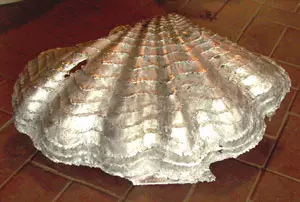 His works eventually found their way into various exhibitions in Mecklenburg-Western Pomerania, Schleswig-Holstein, Brandenburg, and Bremen. He has taken part in symposia spanning a wide range of visual arts, and is also interested in working with wood and concrete. It was only natural, then, that he entered competitions to design entire urban spaces. There is no doubt—though he never says so outright—that he has the energy for such projects, and his ideas extend far beyond the dimensions of a one-man casting mold.
The melt is ready; it must not “boil,” or the casting will be uneven. Utterly focused, Udo Richter pours the contents of the crucible—the liquid, at around 600°C—into the prepared mold. He grows doubtful when the pouring opening fills up, yet the melt does not appear in either of the two air holes.
Just a few minutes later, the casting mold can be removed from the special sand. The metal has solidified—but what shape has it taken?
“Yes!” His relieved shout shows that the work was not in vain. The aluminum shell will soon find its place as a house emblem.
Rainer Höll
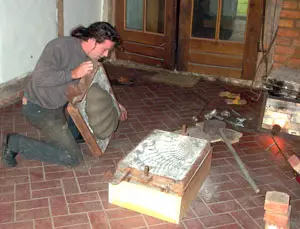 Udo Richter beim Gießen einer Hausmarke (Foto: Rainer Höll)
