
Baltic Sea Nature
The natural world surrounding the Baltic Sea holiday region offers boundless variety. Visitors on a Baltic Sea holiday are immersed in this natural environment. The region’s geological history varies greatly from place to place. While the rock formations in the north are very ancient, some areas on the southern coast took on their present form only around 10,000 years ago. At one site on the Baltic island of Bornholm, on the grounds of the NaturBornholm museum, the boundary between different geological formations is clearly visible.
Even today, however, the Baltic Sea coast is constantly changing. Land uplift in the north, land subsidence in the south, coastal erosion and accretion, the formation or disappearance of islands and land connections, and relics from the earliest ages of the Earth—all of this contributes to the Baltic Sea’s appeal as a holiday destination.
Natural features are often a deciding factor when choosing the Baltic Sea as a holiday destination, whether it’s the sandy beaches of the Baltic coast in Germany, Poland, Denmark and southern Sweden, the skerry coasts of Sweden and Finland, the rocky shores of the Gulf of Bothnia, the shifting dunes and spits in Poland, or the unspoilt beaches of the Baltic states. The natural landscape of the Baltic region also includes inland lakes and rivers that flow into the Baltic Sea. Together, these form vast, interconnected areas for water sports on the Baltic, making the sea accessible for water sports even from the capitals of Baltic countries, such as Berlin or Warsaw.
The coastal location, and especially the continental climate of the eastern Baltic, make the Baltic islands true havens of sunshine. The islands of Rügen, Hiddensee, Bornholm, Usedom, Öland and Gotland vie for the top spot among the sunniest holiday destinations around the Baltic Sea, while Fehmarn in the western Baltic is another contender.
On these pages, we introduce some of the region’s most striking natural features: islands, bays, fascinating coastal landscapes, and protected areas such as national parks, with their valuable flora and fauna, all of which make for interesting day trips. We also cover natural hazards such as storm surges. The extraordinary diversity of the natural world surrounding the Baltic Sea holiday region is what makes it such a valuable place to visit.
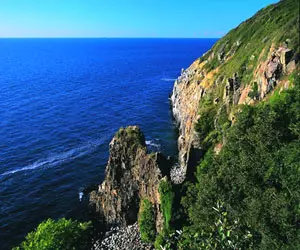 Felsenküste auf Bornholm
Photo: © Henrik Stenberg/www.visitdenmark.de
Felsenküste auf Bornholm
Photo: © Henrik Stenberg/www.visitdenmark.de
