
Cycling along the Elbe-Lübeck Canal: From Lübeck to Lauenburg
“Can’t we hitch a ride on that boat?” Christiane asks her husband Fred with a smile as they get their bicycles ready beside the Elbe-Lübeck Canal in Berkenthin, just as a large cargo ship passes by. “No way,” he waves her off. “We’re here to get some exercise.” The couple from Berlin have barely a week, but on their cycling tour from the Hanseatic city of Lübeck to Lauenburg on the Elbe, far from major roads and surrounded by unspoiled nature, they want to leave as much stress behind as possible.
Their cycling tour follows the well-maintained path along the Elbe-Lübeck Canal, past dense reed beds, grain fields rippling in the wind, and meadows full of colorful wildflowers, first taking them to the village of Krummesse. After eight kilometers, it’s worth stopping for a break here, visiting the church—with its Gothic wall paintings, dating from the early 13th century—and calling in at an ancient inn. “Klempaus Gasthof” has been around since 1577 and has remained in the same family ever since. The country hotel’s family-friendly cuisine has won several awards.
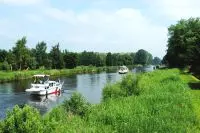 It’s just five more kilometers to Berkenthin. Here, too, there is a beautiful medieval church. The graves of the Stecknitz boatmen in front of it are a reminder of the days of the salt trade. Today’s Elbe-Lübeck Canal grew out of the Stecknitz Canal, built between 1391 and 1398. Salt was transported along it from Lüneburg to Lübeck. Salt was enormously valuable at the time, as it was the only way to preserve food. Trade in “white gold” was the greatest source of income for these cities and the Hanseatic League during the Middle Ages.
The route along the canal today also recalls times long past. Before motorized ships existed, people or animals pulled barges with ropes from what was known as a towpath. Once slippery and boggy, the path has since been transformed into a well-maintained, well-kept cycle route that draws more and more holidaymakers to the tranquil Stecknitz region every year.
Fred Krüger and his wife needed just over two hours to drive from Berlin to the Duchy of Lauenburg on the motorway (BAB 24). They rented comfortable accommodation in Rondeshagen, a neighboring village of Berkenthin: a country house with a fireplace and sauna. In the evenings, they dine at “Meiers Gasthof” in Berkenthin, renowned for its excellent cuisine, and enjoy regional specialties.
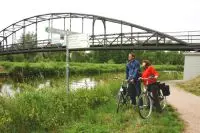 It’s only about ten kilometers from Berkenthin to Ratzeburg. The island town, which has earned worldwide renown for its successful rowers, is dominated by an impressive brick-built cathedral. Around the church, you feel transported back centuries. For the couple from Berlin, visiting the cathedral and the A. Paul Weber and Ernst Barlach museums is a must. They also take a detour to the little sailing harbor below the cathedral and watch the rowers training on the lake.
For the return journey, they choose a route from the Stecknitz region cycling map that passes through the idyllic little village of Groß Disnack. Here, time seems to stand still—a balm for stressed city dwellers.
The third day of their holiday is devoted to Mölln, the town of Till Eulenspiegel. The two holidaymakers begin their stroll in the historic market square, with the Eulenspiegel monument set against the backdrop of the beautiful St. Nicholas Church. The town’s medieval character has been largely preserved here. Till Eulenspiegel is said to have played his pranks in Mölln. Naturally, Christiane and Fred give the thumb and toe of Till’s bronze likeness a good rub, as doing so is said to bring good luck. Then the pair set off to explore the old town, with its winding lanes, stroll along the lakeshore and through the well-kept spa park. For the ride back to Berkenthin, Fred suggests taking the route through Behlendorf. This village, once named the most beautiful in Schleswig-Holstein, is home not only to romantic thatched cottages but also to a wonderfully situated bathing lake.
The next day brings the first small test of the Berliners’ stamina. Today, they plan to cycle along the Elbe-Lübeck Canal to Lauenburg—a good 50 kilometers. That’s why Christiane would have preferred to hitch a ride on the cargo ship. But there’s no backing out, especially with so much to discover along the way.
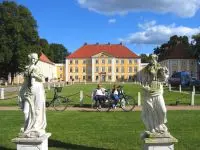 Alongside the beautiful scenery, cultural highlights on both sides of the canal are another regular attraction. Just beyond Güster, the couple takes a short detour to Wotersen estate. This manor house, built in 1737, is a gem of Baroque architecture. Its picture-perfect setting was used as a filming location for the television series “The Guldenburgs.” The little village of Siebeneichen is pure idyll. It has the only ferry across the Elbe-Lübeck Canal, and in this peaceful village it’s well worth visiting the church enclosed by a fieldstone wall.
By late afternoon, they reach Lauenburg on the Elbe. To their great surprise, they find the very cargo ship there that Christiane had wanted to “sign on” with in Berkenthin. A ship on the canal is barely faster than a cyclist on the parallel path. Vessels are allowed to travel at a maximum of ten kilometers per hour, and delays at the locks slow them down considerably.
The little town of Lauenburg is shaped by shipping—above all, of course, by the broad River Elbe, where large cargo ships and tankers ply the water. A particularly lovely sight is the “Kaiser Wilhelm,” a paddle steamer more than 100 years old. It lies against the picturesque backdrop of the old town and, on summer weekends, sets off on excursions along the Elbe.
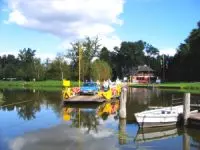 Before setting off the next day, Christiane and Fred take a look at the Palmschleuse in Lauenburg. It is the oldest surviving chamber lock in Central Europe. This is where boatmen once began the arduous journey of transporting salt to Lübeck. In the Middle Ages, it took them about three weeks to travel one way along the winding Stecknitz Canal. Today, experienced cyclists can easily cover the 60-odd kilometers in a day. But anyone who prefers a leisurely pace, wants to take in this beautiful corner of Schleswig-Holstein and relax along the way should allow a week for the tour and the many sights on both sides of the route.
Further information
TouristService Stecknitz-Region, Am Schart 16, 23919 Berkenthin,
Tel. 04544/80010, info@stecknitz-region.de, www.stecknitz-region.de
Text and photos © TouristService Stecknitz-Region / LOGO Touristik PR
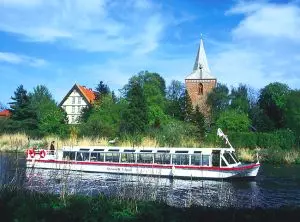 Radtour entlang des Elbe-Lübeck-Kanals - Berkenthin (Foto © TouristService Stecknitz-Region / LOGO Touristik PR)
