
Sea buckthorn – the lemon of the north
Sea buckthorn, also known in old German as sand berry, sea thorn, shore thorn or dune thorn, is a member of the oleaster family with a long history: in Mongolia, the plant was already being used as a remedy for horses’ eyes. This is also the origin of its scientific genus name: Hippophae (hippos means horse and paos means light). Hippophae rhamnoides is the Latin name for sea buckthorn. The botanical species name Rhamnoides means “resembling buckthorn” and refers to the buckthorn shrub. The name probably comes from its preferred habitat: coastal dune areas or the sandy soils of the Havelland region in Brandenburg.
Typical identifying features include the thorns on its branches and its willow-like leaves, which feel silvery-white underneath. The inconspicuous flowers appear from March to May, and the first bright orange berries can be found from late August through late October, depending on the variety. To the delight of birds, the berries remain firmly on the branches throughout the winter. The nutty-tasting seed, which contains a highly valuable kernel oil, is surrounded by soft pulp. The pulp contains an oil that is no less valuable. Together, the whole berry tastes sour to tart, somewhat like freshly pressed sea buckthorn juice.
The plant originated in Asia, where the vast steppes provide ideal conditions for its growth. Sea buckthorn species even grow in the Himalayas at elevations of up to 5,000 metres, although there they are only about 10 cm tall and produce berries that can contain up to 19% kernel oil.
Sea buckthorn has also been native to Europe since the last Ice Age, primarily around the North and Baltic Seas. In Germany, it also grows along roads and motorways (best not to harvest it there), by rivers, and in gardens and parks. It is cultivated on a plantation scale in the CIS countries, Mongolia, China and Germany.
How can you harvest sea buckthorn without bursting the berries or hurting your fingers? Harvesting is a laborious, time-consuming process. Some people squeeze the juice straight from the branch, a method known as “milking.” However, this can lead to heavy losses of both fruit and skin, and may cause the shrub to wither prematurely. Another method, no better than the first, is the traditional shaking or stripping. Cloths are spread beneath the bush, and the berries are then loosened from the branches with wooden tools (never metal!). Another option is to hand-cut the fruit-laden branches. You have to choose them carefully, as in principle the shrub should only be harvested every two years. The fresh branches are then packed into large crates and flash-frozen in a cold store at minus 38°C. After 3–4 days, the berries are shaken off using a vibrating machine, cleaned and stored frozen until sale. They are then freshly processed as needed.
In recent decades, sea buckthorn and products made from it—such as juices, spreads, syrups, teas and wines—were used more or less exclusively by those in the know. Now, however, the fruit is enjoying a tremendous boom in Germany and beyond. Sea buckthorn is in. As consumers seek wholesome, unadulterated foods, sea buckthorn products are highly popular. Sea buckthorn is not only an excellent source of vitamin C (its vitamin C content is higher than that of lemons or blackcurrants), but also a true multivitamin powerhouse with considerable health benefits. It contains other valuable vitamins, including provitamin A, vitamin E and vitamin K.
Sea buckthorn oil – the gold of the sea buckthorn berry
When people think of sea buckthorn, they think of a power fruit, a source of vitamin C, or the hardy thorny shrub found in hedges and gardens or among the dunes of the Baltic and North Seas. Less well known, but extremely interesting, is sea buckthorn oil—a gem of natural medicine, containing substances found in no other oil.
In Central Asia and Scandinavia, the lipids found in the fruit pulp and nut-like seed kernel—which are otherwise rare in the plant kingdom—have been used in medicine and cosmetics for centuries.
A distinction is made between pulp oil and kernel oil. Sea buckthorn oil pressed from the pulp is a vivid orange-red and has a distinctive fruity, oily taste. The nutritional and cosmetic properties that make sea buckthorn oil so interesting are reflected in its high levels of biologically active substances: carotenoids (especially provitamin A), 30 to 120 mg; vitamin E (tocopherol), 50 to 150 mg per 100 g of oil; phytosterols; and essential fatty acids. One to two teaspoons of sea buckthorn pulp oil provide a person’s daily requirement of provitamin A and vitamin E.
Sea buckthorn pulp oil acts as a free-radical scavenger and supports tissue rejuvenation through cell renewal. This unique plant oil is therefore a sought-after active ingredient in specialist anti-ageing cosmetics and is also used in medicine to promote wound healing.
Sea buckthorn kernel oil is becoming increasingly well known among people with atopic dermatitis. Its distinctive range of polyunsaturated fatty acids and other natural ingredients may help regulate impaired and often overactive skin functions. Sea buckthorn oil has no adverse effects on biochemical processes in the body. On the contrary, it offers so many beneficial effects when used internally and externally that anyone who tries it will soon find it hard to do without.
Constanze Seibold
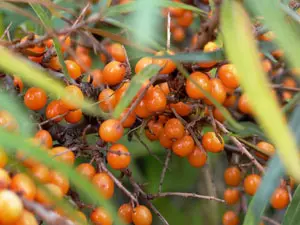 Sanddornbeeren (Foto: nordlicht verlag)
