
Nida: Dunes and Coastal History
Accommodation in Nida
Nida is a popular holiday resort and the largest settlement on the Curonian Spit. These two characteristics offer different points of reference: its size places Nida within the peninsula, while its character as a holiday resort describes it as a travel destination. If you are deciding where to stay on the Spit, this description of the place can be paired with specific interests. In Nida, an easily accessible dune, a route exploring the heritage of the gliding school, and an ethnographic homestead come together. These themes range from landscape to a clearly defined episode in aviation history and the way of life of fishing families. This means you can choose the destination based on more than a single excursion: the different points of interest appeal to different visitors.
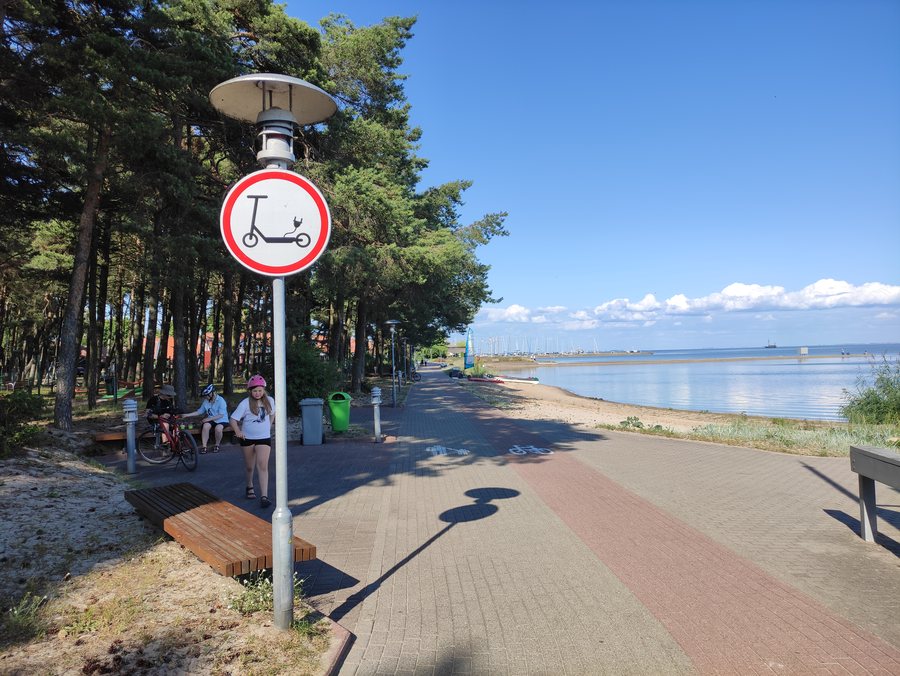 File:Pobřeží v Nidě, Nida, Neringa.jpg
Photo: Fry72, Karel Frydrýšek via Wikimedia Commons, CC BY-SA 4.0
Parnidis Dune and the Sundial
Parnidis Dune is not far from the center of Nida and is easy to hike, including for families with children. A large sundial stands on the dune. The natural formation and the sundial are therefore part of the same destination: visitors who want to experience the dune as a landscape will also encounter a clearly identifiable object on it. These two details help visitors understand the destination in different ways. Its proximity to the center describes the dune’s location in relation to Nida; its ease of access describes what makes the walk distinctive. For families with children, the easy walk is one of the defining features of this natural attraction. The sundial adds a specific object to explore as part of a visit to the landscape. Parnidis Dune can therefore be the nature-focused highlight of a trip.
Following in the Footsteps of the Gliding School
The “In the footprints of the gliding school of Nida” route explores the heritage of the gliding school, which was active from 1933 to 1939. Seven orange markers along the route tell stories about its staff and students. This gives the subject a time frame and a human perspective: the focus is not only on the school itself, but also on the people who worked and studied there. You can experience the route alone or in a group. This choice affects how you experience it, while the historical subject remains the same. The seven markers structure the experience around several stories, rather than describing the institution only by its years of operation. For travelers interested in education, gliding, or local history, this is a different way to get to know Nida than visiting the dune. The school’s operating years, from 1933 to 1939, provide a clear time frame for its history.
The Nida Fishermen’s Homestead
The ethnographic Nida Fishermen’s Homestead shows the authentic home of a fishing family and the unique coastal way of life that sustained Curonian families for centuries. The focus is therefore not only on fishing as an activity, but also on a way of life whose importance endured over a long period. This perspective differs from that of the gliding route: the route focuses on a school that operated from 1933 to 1939, while the homestead is about coastal life over centuries. This contrast brings two different scales of local history into view without equating the subjects. The home of a fishing family gives the story a tangible human connection, while the coastal way of life provides the broader context. Visitors interested in how a fishing family lived and the role the coast played in the lives of Curonian families will find a fitting way to explore the subject here.
Discover more destinations: Kretingalė, Šilutė, Vileikiai, Kintų Seniūnija, Žibininkai, Neringa, Pervalka, Dreverna.
For the broader travel overview: Klaipėda County.

