
Gresse: Village Church, Finkenberg and Manor House
Accommodation in Gresse
Gresse can be explored through three distinct local features: the village church on a hill, Finkenberg with its burial mound, and the manor house on the Boize. They raise different questions for planning a trip—about the impact of a church building, the uncertain interpretation of a hill, and the architectural history of a manor house. If you are looking for a hotel in Gresse, you can use these highlights to help choose where to stay.
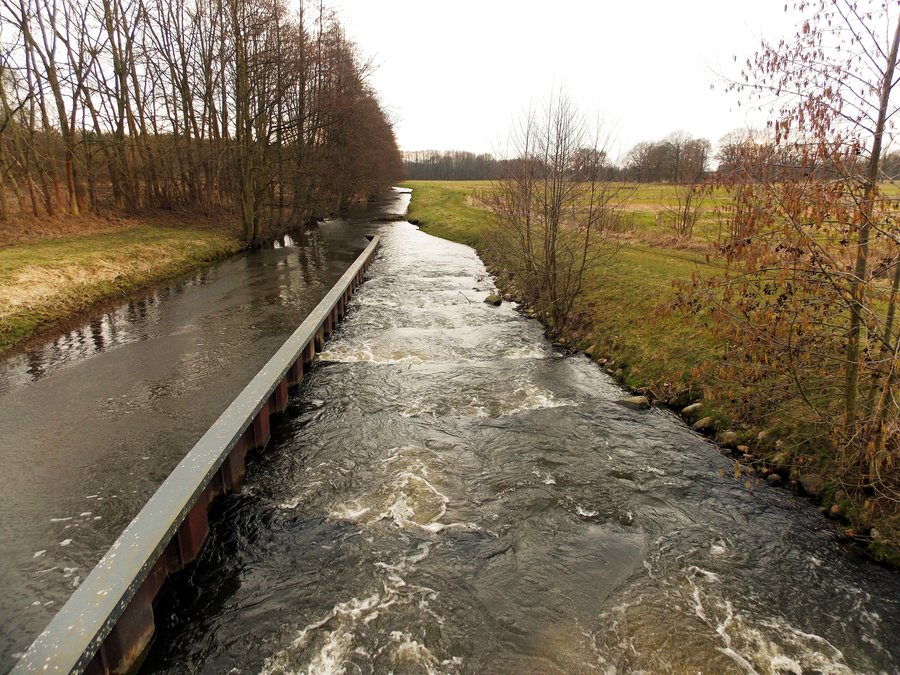 File:Fischtreppe am Wehr Gresse Bild 1.jpg
Photo: infestus_969 via Wikimedia Commons, CC BY-SA 3.0 DE
Village Church and Churchyard
Gresse’s village church stands on a hill and is hidden behind old trees. Its location is part of the building’s appearance: the elevation and trees shape the view of the church. At its core is a half-timbered structure dating from the late 17th century. The location and construction thus offer two distinct points of interest: first, the hill and old trees; then, a closer look at the half-timbering and its historical period. In autumn and winter, the church is illuminated, making it a striking sight during the dark season. In these months, the seasonal lighting adds to the architecture and distinctive setting.
The churchyard includes a burial chapel, three soldiers’ graves and a 1939–45 war memorial. These places of remembrance add another dimension to a visit to the church. Those interested in local history will find not only the church itself, but also a churchyard with a variety of memorials.
The Route to Finkenberg
Another highlight is Finkenberg. From the village of Gresse, cross the B195 and follow Lindenweg for 750 metres. You can leave your bicycle at Finkenberg; from there, a footpath leads into the wooded area after a few metres, where you will find the impressive burial mound. This sequence is useful for finding your way: the B195 and Lindenweg mark the approach, followed by the footpath into the woods. Check local path conditions before your visit, as they may change.
The mound’s interpretation is also part of the experience. It looks like an impressive Bronze Age barrow, but it is unclear whether it is actually a prehistoric monument. It may have been constructed by the local landed gentry in the 19th century. The Bronze Age interpretation should therefore not be treated as a confirmed date. Its appearance and origins cannot be reduced to a single definitive story; this open question is precisely what distinguishes Finkenberg from a building with a clearly stated construction date.
The Manor House and Its Architectural History
Gresse’s manor house stands on a small island in the middle of a beautiful park on the Boize. Here, the interplay between the building, the park and its riverside setting takes centre stage. The manor house was newly built in 1850/60 in the Tudor style by the architect Heinrich Gustav Thormann. Both its construction period and architectural style are important to understanding the building: they provide a specific architectural reference point, while the island setting shapes the character of the place. In contrast to the elevated village church with its half-timbered core, the manor house offers a different perspective on Gresse’s architectural history.
Cultural Attractions in the Wider Ludwigslust-Parchim Destination
The wider Ludwigslust-Parchim destination also offers cultural points of interest with a different focus. Ludwigslust Palace was the former residence of the Dukes of Mecklenburg and, together with its park and town, forms an ensemble known as the “Little Versailles of the North.” The palace lies at the heart of an almost completely preserved late Baroque town layout, with a former court church and an English-style landscape park. The palace presents the art and courtly domestic culture of the 18th and early 19th centuries. This history of the palace and town is a distinct regional point of interest; it does not describe Gresse itself.
Discover more destinations: Teldau, Tessin B. Boizenburg, Nostorf, Greven, Besitz, Bengerstorf, Brahlstorf, Dersenow.
For the wider travel overview: Amt Boizenburg-Land.

