
Mestlin: Cultural Centre and Architectural Ensemble
Accommodation in Mestlin
In Mestlin, the cultural centre shapes the view of the town: it was built between 1954 and 1957 as a village centre and forms the heart of the former socialist model village. Because of its uniqueness and importance to the history of the GDR, it is considered a rare monument of national significance. Those who want to focus their stay on architectural and cultural history will find a clear focal point here. At the same time, Mestlin lies on the edge of Nossentiner/Schwinzer Heide Nature Park and the Sternberg Lake District. The town’s history and its landscape setting are two distinct starting points for planning a trip.
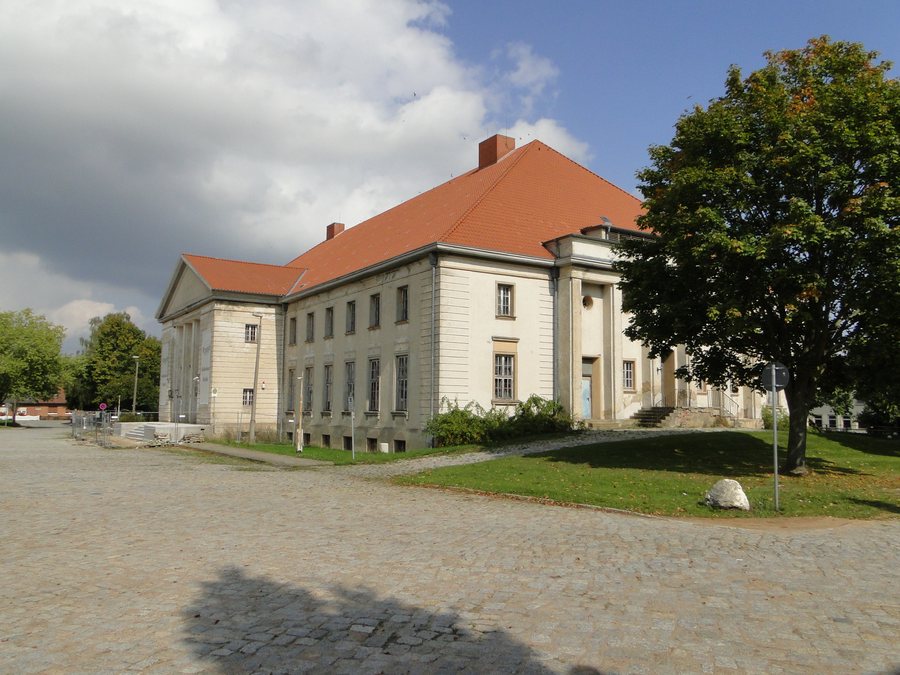
The Cultural Centre and Its Architecture
The cultural centre is a two-storey, plastered brick building. Its square-facing façade is defined by a projecting, three-bay portico with a triangular pediment. The projection creates a striking accent in front of the façade; the triangular pediment forms its uppermost section. The large hipped roof rises above the other buildings and makes the building visible from afar. The roof silhouette and the articulated square-facing façade offer two distinct features: one shapes the building’s distant appearance, while the other defines the view of its front. This makes it possible to understand the cultural centre not only in terms of its function as a village centre, but also through its specific design.
The Former Model-Village Ensemble
Since 1977, the socialist model-village ensemble in Mestlin has been protected as an architectural ensemble. In addition to smaller apartment blocks, the former model village includes the former nursery and kindergarten, the school, several residential and commercial buildings on Marx-Engels-Platz, and the former rural outpatient clinic. The different building types highlight the importance of distinguishing between the cultural centre as the heart of the village and the larger ensemble: the historical context also includes buildings for housing, education, childcare and services, alongside the village centre. The model village can therefore be understood as an ensemble, not just as a single prominent building.
Grounds, Interior and Culture
The cultural centre’s grounds include a sports field and a large park. The discotheque and its technical equipment have been preserved inside, offering nostalgic GDR charm from the 1970s and 1980s. This adds further specific aspects to the building’s exterior appearance: the design of the grounds and a preserved interior. Since 2008, the Denkmal Kultur Mestlin e.V. association has been working to preserve, gradually renovate and use the cultural centre. It organises exhibitions, events, concerts, theatre performances and readings. If you would like to tie your stay to a particular event, check the current schedule before travelling.
Church History and Landscape Setting
The church in Mestlin also offers its own historical perspective. It belongs to the Evangelical-Lutheran Parish of Mestlin-Techentin-Kladrum; the choir from the first church building has survived to this day. Here, a present-day church affiliation meets a surviving architectural element. This offers a different perspective on Mestlin from the history of the cultural centre, which dates from the 1950s and is regarded as the heart of the former socialist model village. When choosing where to stay, you can weigh up different interests: the architectural history of the village ensemble, church history or the location on the edge of two landscapes.
Discover more destinations: Techentin, Neu Poserin, Dobbertin and Goldberg.
Return to the overarching travel overview: Goldberg-Mildenitz Municipal Association.

