
Hülseburg
Accommodation in Hülseburg
Hülseburg can be explored through the history of its former estate complex, its preserved park, and a cycling route that leads into the former park. When planning your trip, it is important to distinguish between the vanished castle and the landscape features that remain: Hülseburg’s history cannot be reduced to a castle building that still exists today. The building history, park, and cycling route offer different starting points for deciding whether Hülseburg suits your travel interests.
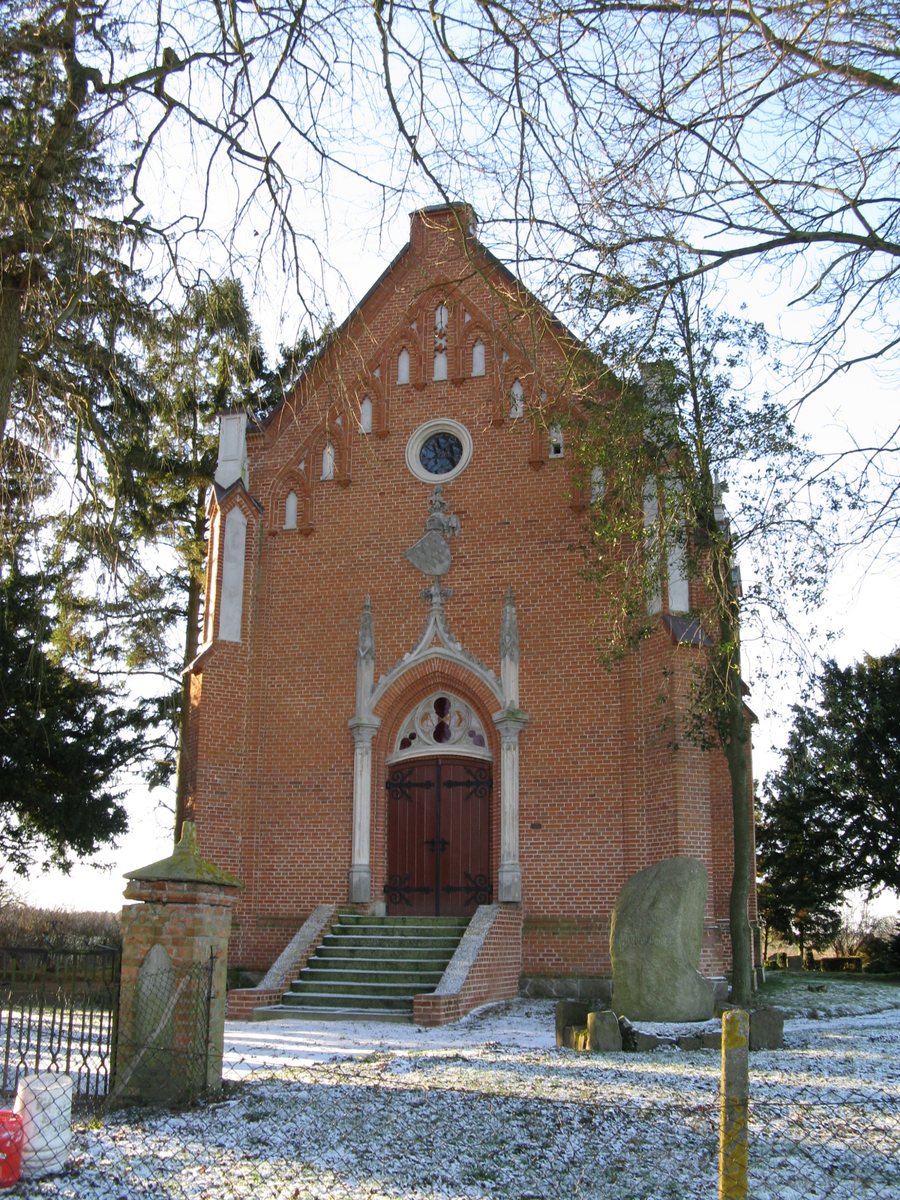 File:Hülseburg Kapelle 2009-01-05 052.jpg
Photo: Niteshift ( talk ) via Wikimedia Commons, CC BY 3.0
Estate and Castle History
In 1779, a new manor house and an orangery were built at the Hülseburg estate, and a game park was laid out. From 1861 onward, Hülseburg Manor House was built in the English Tudor Gothic style. The estate’s history therefore includes both specific buildings and the design of their surroundings: the manor house and orangery are architectural elements of the estate’s history at the time, while the game park was part of the estate’s layout.
In January 1947, the manor house burned down to its foundations, probably as a result of arson. The former Neo-Gothic castle has not existed since 1948. The former castle’s park has been preserved. The architectural and landscape traces are therefore distinct: the manor house belongs to the lost building fabric, while the park is part of the complex that survives to this day.
Surviving Traces in the Park and Estate
Remains of an artificial castle ruin, commissioned there by Albert von Campe, have survived in the park. Hülseburg’s earlier history includes a castle complex surrounded by a moat. The Inspector’s House, built in 1858, is the surviving building of the former estate complex. The artificial ruin points to a landscaped park, while the Inspector’s House, as a surviving building, represents the architectural part of the former estate complex.
An impressive avenue leads to the Hülseburg Chapel. It is another notable point of reference in the history of the estate and landscape. Hülseburg’s traces include both surviving features and buildings and grounds whose history belongs to the past; this distinction helps put the place’s different themes into context.
Cycling Route and Orientation
A cycling route leads to Hülseburg, into the former park, and then about 250 metres farther to a motte with a ditch. The 250 metres refer only to the continuation to this terrain feature, not to the length of the entire tour. This helps you factor the distance into your own schedule without mistaking it for the length of the full ride. If you plan to take the route, check current trail conditions before setting off.
Context Within the Ludwigslust-Parchim Travel Destination
Within the broader Ludwigslust-Parchim travel destination, Ludwigslust Palace offers a different architectural accent: it was the former residence of the dukes of Mecklenburg and, together with its park and town, forms an ensemble known as the “Little Versailles of the North.” The palace is the centrepiece of an almost completely preserved late Baroque town complex with a former court church and an English landscape park. It presents art and courtly domestic culture from the 18th and early 19th centuries. The broader travel destination thus brings together different historical interests: the estate and park history of Hülseburg and the palace residence and town complex of Ludwigslust.
The Dömitz Citadel in the broader Ludwigslust-Parchim travel destination also offers a distinct architectural contrast. Built as a Renaissance fortress on the Italian model, it is pentagonal in shape, with bastions, casemates, and a drawbridge. This extends the cultural comparison from Hülseburg’s estate and castle history to a fortification with a different architectural style.
Discover more destinations: Strohkirchen, Setzin, Moraas, Hoort, Gammelin, Bandenitz, Warlitz, Picher.
For the broader travel overview: Amt Hagenow-Land.

