
Schwanheide: Chapel History and Bird Sanctuary
Accommodation in Schwanheide
Those considering Schwanheide as a travel destination can focus on two different topics: the history of the chapel and the EU bird sanctuary “Wallmoor and Mühlenbach Lowlands near Leisterförde – Schwanheide.” This allows the local religious history and a named protected area to be considered as separate interests when planning a trip.
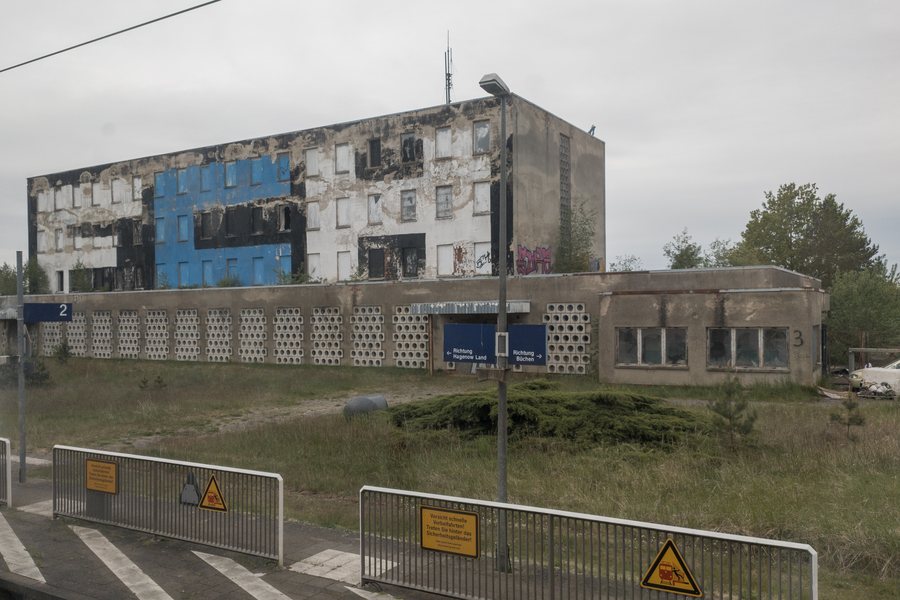 File:Train station, Schwanheide (LRM 20200518 085705).jpg
Photo: Matti Blume via Wikimedia Commons, CC BY-SA 4.0
Schwanheide Chapel and Its Bell History
Schwanheide Chapel was consecrated on June 19, 1955, and was initially known as a “Christian instruction barracks.” The bell is also part of its story: the bell from St. George’s Church in Zweedorf dates back to the 17th century, was stored in Schwanheide, and inspired the wish to build a bell tower at the chapel. The bell’s origin, where it was stored, and the resulting desire for a tower link the histories of the two church sites. Those interested in local history will find here not only the exact consecration date, but also a story centered on a specific object.
Church Art in Zweedorf
Zweedorf is part of the municipality of Schwanheide. The new St. George’s Church there was consecrated on September 4, 2012. Its stained-glass windows were designed by artist Thomas Kuzio. The altar, baptismal font, and ambo were created by wood sculptor Barbara Wetzel. The contributions can be distinguished by their form: stained glass on the one hand, and three named furnishings on the other. A baptismal font is the basin used for baptisms; an ambo is a liturgical reading stand. This makes the nature of the different works clear even without prior knowledge of art history. In the municipality of Schwanheide, these features complement the chapel’s bell history with a distinct perspective on the design and furnishings of a church.
EU Bird Sanctuary near Schwanheide
The EU bird sanctuary “Wallmoor and Mühlenbach Lowlands near Leisterförde – Schwanheide” is in Mecklenburg-Western Pomerania and covers 2,308 hectares. Bird species listed in Annex I of the Birds Directive include the common crane (Grus grus). These two details provide different kinds of orientation: the area figure conveys the extent of the named protected area, while the crane is a specific species from the listed group. For your travel plans, this offers a nature-focused perspective that is clearly distinct from Schwanheide’s religious and art-historical topics.
More Cultural Topics in the Wider Ludwigslust-Parchim Travel Destination
In the wider Ludwigslust-Parchim travel destination, Ludwigslust Palace offers a distinct window into court history. It was the former residence of the Dukes of Mecklenburg and forms, together with the park and town, an ensemble known as the “Little Versailles of the North.” The palace is also the centerpiece of an almost completely preserved late-Baroque town plan, with a former court church and an English-style landscape park. The palace presents art and courtly domestic culture from the 18th and early 19th centuries. Thus, alongside the church-related sites in Schwanheide and Zweedorf, palace history and a late-Baroque town plan are available as distinct cultural topics in the wider travel destination.
Another cultural site in the wider Ludwigslust-Parchim travel destination is Zarrentin Monastery. The ground floor houses a permanent exhibition about the monastery; guided tours are also offered on the history of the former Cistercian convent, the nuns’ lives, and the building’s architecture. Dates and access may change, so it is advisable to check before visiting.
Discover more destinations: Dersenow, Greven, Nostorf, Brahlstorf, Tessin B. Boizenburg, Bengerstorf, Teldau, Neu Gülze.
To the wider travel overview: Amt Boizenburg-Land.

