
Discover Glewitz: Church, Organ and Historic Architecture
Accommodation in Glewitz
A central cultural and historical feature of Glewitz is St. Margaret’s Church. Its choir was built at the end of the 13th century and has unusually High Gothic proportions for a village church. Another special feature is its wall paintings, rediscovered in 1995. Their style, scope and state of preservation make them a significant architectural monument for the whole of northern Germany. For your travel plans, the church brings together two distinct aspects: the choir’s distinctive design and the decorative paintings, whose significance extends beyond the local area.
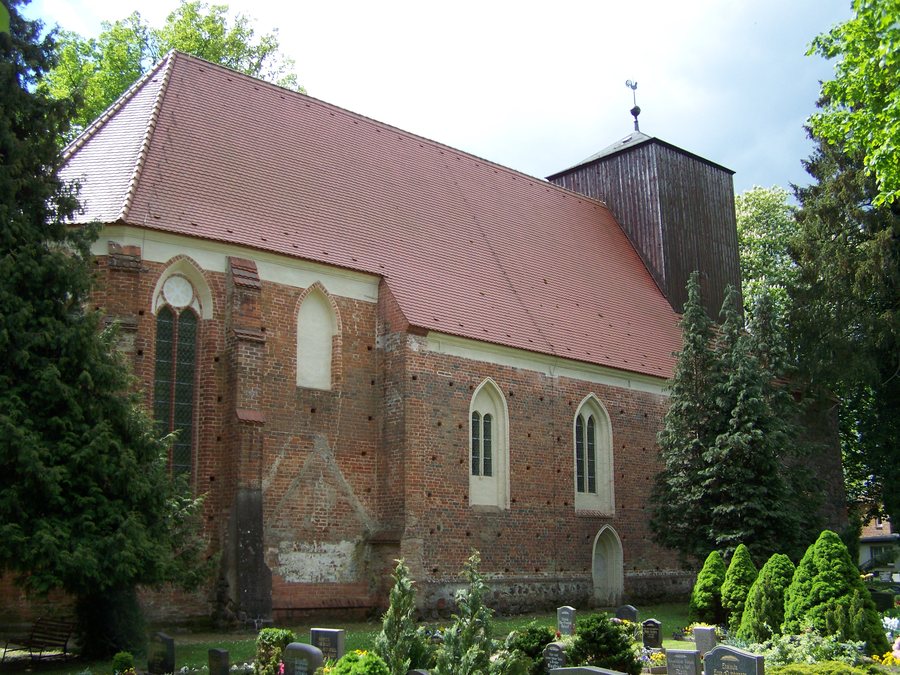 File:Kirche in Glewitz, Vorpommern (2009-05-13).JPG
Photo: Klugschnacker via Wikimedia Commons, CC BY-SA 3.0
The church is home to the Schulze organ, built in 1844 by organ builder Johann Friedrich Schulze (1793–1858) from Paulinzella in Thuringia. It has 435 pipes, arranged across ten stops, one manual and a pedal. These specific details offer insight into the instrument’s layout without reducing it to a single number. In 2004, the organ was restored by the Alexander Schuke organ-building company from Potsdam. Its year of construction, builder and restoration give it a distinctive history of craftsmanship and time, adding another cultural and historical theme to the church building.
Glewitz churchyard also bears witness to the past: it contains gravestones from the 18th and 19th centuries. These offer a different perspective from the choir and organ. While the church brings together architectural history and instrument making, the gravestones are part of the local culture of remembrance. Those interested in cultural history can thus see the different ways in which Glewitz’s past remains tangible.
Turow Water Castle is a historic castle in Mecklenburg-Western Pomerania, first mentioned in a document around 1237. The Blue Chapel is located inside the castle and dates from the 18th century. Its cross-vault is supported by a central column. This is a striking architectural detail: the vault is supported not by several side supports, but by a column in the middle. The castle, chapel and vault thus offer a distinct historical focus alongside Glewitz’s own heritage. The approximate date of the castle’s first mention and the dating of the chapel refer to different aspects of the complex.
Two routes at the junction in Glewitz are relevant for getting around by road. The town lies directly on the Grimmen–Demmin state road, which runs north–south. At the same junction, the Greifswald–Tribsees–Rostock state road also crosses it in an east–west direction. If you choose Glewitz as your destination, these details offer a factual overview of the roads that pass through the town, without specifying a particular route or travel time.
The nearest rail connection to Glewitz is in Grimmen, on the Stralsund–Berlin line. This differs from the information about the two roads that cross directly in Glewitz: Grimmen is identified as the nearest rail connection. This information can help you take transport links into account when choosing your destination, without treating road and rail connections as equivalent.
Other places in the same selection are Splietsdorf, Millienhagen-Oebelitz, Wendisch Baggendorf, Franzburg, Velgast, Gremersdorf-Buchholz, Weitenhagen and Papenhagen.
For the broader travel overview: Amt Franzburg-Richtenberg.

