
Velgast: Manor House History and Cycling Routes
Accommodation in Velgast
When choosing a destination for a trip to Vorpommern-Rügen, it is worth considering Velgast and the municipality it belongs to. Velgast has been connected to the railway for more than 100 years. The area also offers manor house history, brick architecture, and specific opportunities for cycling and nature experiences. The following highlights range from Velgast itself to other places in the municipality.
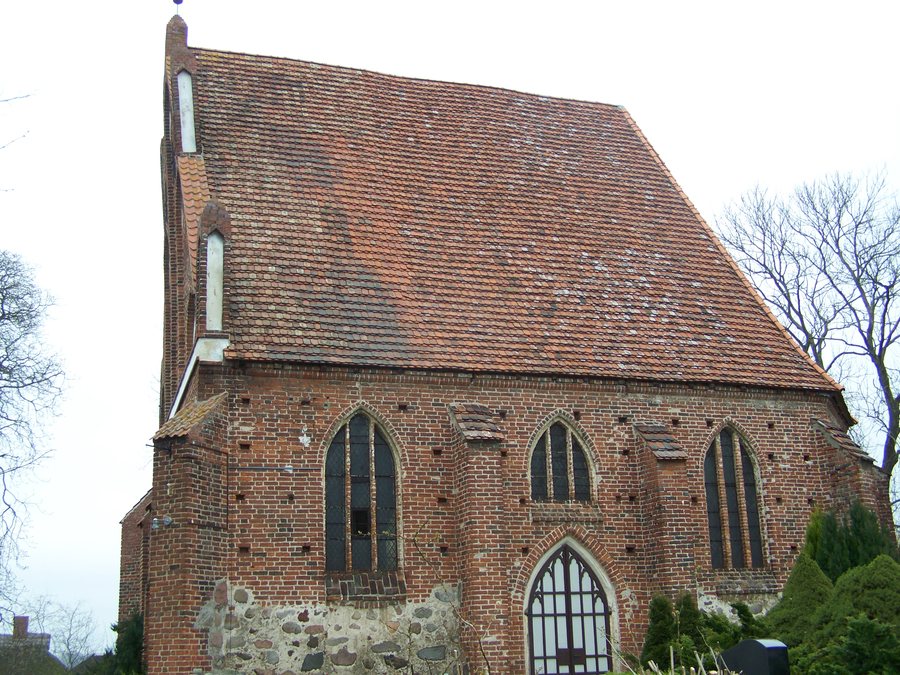
Manor House History and Brick Architecture in the Municipality
Today’s manor house in Velgast was built in 1833/34 and remodeled in the years that followed. In Schuenhagen, the history of the forestry office goes back more than 200 years, to the era of Swedish Pomerania. The listed forestry lodge at Kronenwald 1 is a brick building with an ornamental gable and is considered an example of Prussian administrative architecture. It continues to serve as the Schuenhagen Forestry Office and lies directly on the Barthe. The river crosses the municipality of Velgast and flows into the Barther Bodden at Barth.
In Starkow stands the richly decorated, three-aisled brick basilica of St. Jürgen, dating from the 13th century. Expanded around 1300, it is considered one of the earliest brick churches in Western Pomerania; the German Foundation for Monument Protection classifies it as a “building of regional significance.” The church houses a Mehmel organ built in 1860, with 17 stops. It was rededicated in 2010 after extensive restoration and comes from the workshop of Stralsund organ builder Friedrich Albert Mehmel.
The historic ensemble in Starkow also includes the rectory, school and sexton’s house, parish barn, preacher’s widow’s house, and historic rectory garden with an orchard meadow. The garden has significant value for garden history and local heritage and is well suited to a stroll. Garden tours take place during events or on request. Starkow is located in the “Barthe” landscape conservation area.
The cultural program in Starkow also offers a variety of events throughout the year: the “Baumblütenfest” (Tree Blossom Festival) takes place at the start of the season in early May, while the “Appeldag” is held every October. There are also changing art exhibitions, readings, and concerts. Check the specific event dates before your trip. The playground on Kirchsteig has a climbing frame, slides, swings, and a large sand area; facilities may change, so it is advisable to check the latest information before your visit. In Bussin, the Luisenhöhe manor house was built around 1770/80. It is named after Queen Louise, the mother of Emperor Wilhelm I.
Cycling, Forests, and Seasonal Nature Experiences
Route 5 A of the Bodden Coast Tour runs from Barth via Kenz, Löbnitz, Starkow, Velgast, Groß Kordshagen, Günz, Nisdorf, Groß Mohrdorf, Hohendorf, Barhöft, and Klausdorf, then returns to Barth via Hohendorf, Nisdorf, and Glöwitz. This makes Velgast one stop on a longer described cycling loop; the listed places show how it passes through several locations rather than describing a single short route in the area. Starkow can also be reached via federal highway 105 and the turnoff to Starkow.
In Schuenhagen, the nature trail “Der Baumschatz von Schuenhagen” (Schuenhagen’s Tree Treasure), which opened in 2022, winds through a small, species-rich woodland. Information boards share facts about native tree species, and a quiz lets visitors discover the “tree treasure” in an ancient oak at the end of the walk. The white-tailed eagle trail at the Schuenhagen Forestry Office offers insights into the white-tailed eagle’s way of life and migration patterns. It is free of charge and open year-round; if access information is important to you, check it before your visit.
The access route to the Klimawald Schuenhagen reforestation area is via the L 212, near Schuenhagen. Parking is available at the forestry office; signs point the way from there, followed by a roughly 200-meter walk to the site. In Manschenhagen, you can observe the annual crane migration in autumn and spring: the birds travel toward southern Europe or Scandinavia. So, alongside cycling and learning about forests, there are nature-watching opportunities tied to specific seasons.
Routes in the Wider Vorpommern-Rügen Travel Region
Exploring the wider Vorpommern-Rügen area may also be useful when planning your routes. The North Western Pomeranian Forest Landscape is crossed by the Baltic Sea Cycle Route and the Hamburg–Rügen long-distance cycle route. Other regional cycling routes include the “Östlicher Backsteinweg,” the “Fischland-Darß-Rundweg,” the “Recknitztalrundweg,” and the “Trebeltalrundweg”; they run through or along the edge of “Schreiadlerland.”
There are also regional hiking routes: the Via Baltica and the 400-kilometer Baltic Sea Hiking Trail E 9 cross the North Western Pomeranian Forest Landscape. If you are looking for accommodation, you can weigh up Velgast as a destination based on its historic buildings, seasonal events, and varied cycling and nature experiences.
Discover more destinations: Wendisch Baggendorf, Weitenhagen, Splietsdorf, Glewitz, Gremersdorf-Buchholz, Millienhagen-Oebelitz, Franzburg, Papenhagen
Return to the wider travel overview: Amt Franzburg-Richtenberg.

