
Discover Sagard: Brunnenaue, Church and Chalk
Accommodation in Sagard
Sagard offers historical points of interest at Brunnenaue and St. Michael’s Church. In the municipality, in Gummanz, you’ll find the Rügen Chalk Museum, with exhibits on chalk and fossils. The town’s history, museum exhibits and routes in the surrounding area can therefore be approached as distinct travel interests.
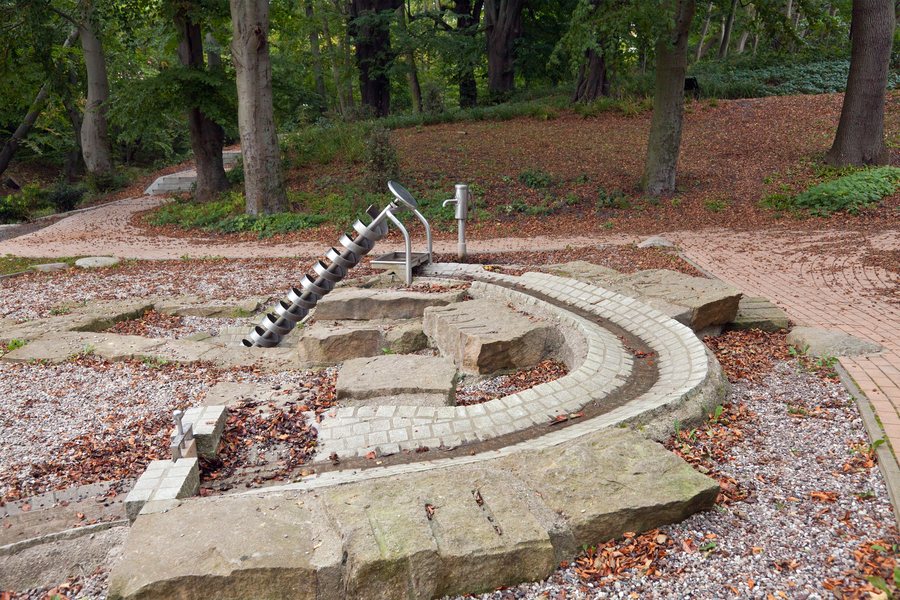
Brunnenaue and St. Michael’s Church
Brunnenaue is a small, idyllic spot in the heart of Sagard. The town’s historic spa was located here: in 1795, Sagard’s pastor founded the first spa on Rügen at Brunnenaue, next to the church. The site of the former spa thus connects a specific place in Sagard with the history of spa culture on the island.
St. Michael’s Church is one of the oldest houses of worship on Rügen. It was built around 1210 as a single-nave, late Romanesque hall church without a tower. Together with the later history of the spa, it offers a distinct perspective on Sagard’s past: here, medieval architectural history sits alongside the start of spa operations in 1795.
Chalk and fossils in Gummanz
The Rügen Chalk Museum in Gummanz focuses on chalk, its extraction on Rügen and the fossils embedded in it. The grounds include an open-air museum with a chalk quarry, a chalk lake, a nature trail and a viewpoint overlooking the chalk cliffs. The exhibits range from the raw material and its extraction to the traces found in the chalk.
The nature trail starts at the museum, loops around the Gummanz chalk quarry and continues to the “Little Königsstuhl.” With a little luck, you can find your first fossils in the outdoor “digging box”; fossils you bring along can also be identified. The museum and its grounds are accessible to people with disabilities and suitable for strollers. If step-free access is important for your plans, please confirm the access conditions before your visit.
Routes and archaeological traces
The northern section of the “Romantic Rügen” themed circular trail starts and ends in Sagard. It is 16 km long and runs through the interior of the Jasmund Peninsula. The published distance offers a specific reference point for planning your day; check current trail conditions before setting off.
The Quoltitz sacrificial stone is located within the municipality, north of Neddesitz on the Jasmund Peninsula. The granite boulder is one of the largest on Rügen. Traces of early human working are visible on it, probably dating back to the Bronze Age. The Dobberworth is also located near Sagard: the burial mound is 12 m high and the largest on Rügen. The two sites offer different archaeological perspectives—visible signs of human working on a boulder and a burial mound notable for its height.
The wider regional context
Within the broader travel destination of Vorpommern-Rügen, the district of Vorpommern-Rügen includes the island of Rügen and the nearby islands of Hiddensee and Ummanz. The Fischland-Darß-Zingst peninsula chain is also part of this district. The beech forests in Jasmund National Park on Rügen form part of the UNESCO World Heritage site “Ancient and Primeval Beech Forests of the Carpathians and Other Regions of Europe.”
Discover more destinations: Glowe, Dranske, Breege, Lohme, Altenkirchen, Wiek on Rügen, Putgarten.
View the wider travel overview: Amt Nord-Rügen.

