
Drechow: Stone Church and Manor House
Accommodation in Drechow
When choosing a travel destination, a clear historical connection can make all the difference. In Drechow, the Protestant Church of St. Mary offers just that: a fieldstone building dating from the 13th or 14th century. The dating leaves open two possible centuries and places the building in a medieval timeframe. This provides a starting point for exploring the area, with a specific building and an architectural style that draws attention to the history of the village.
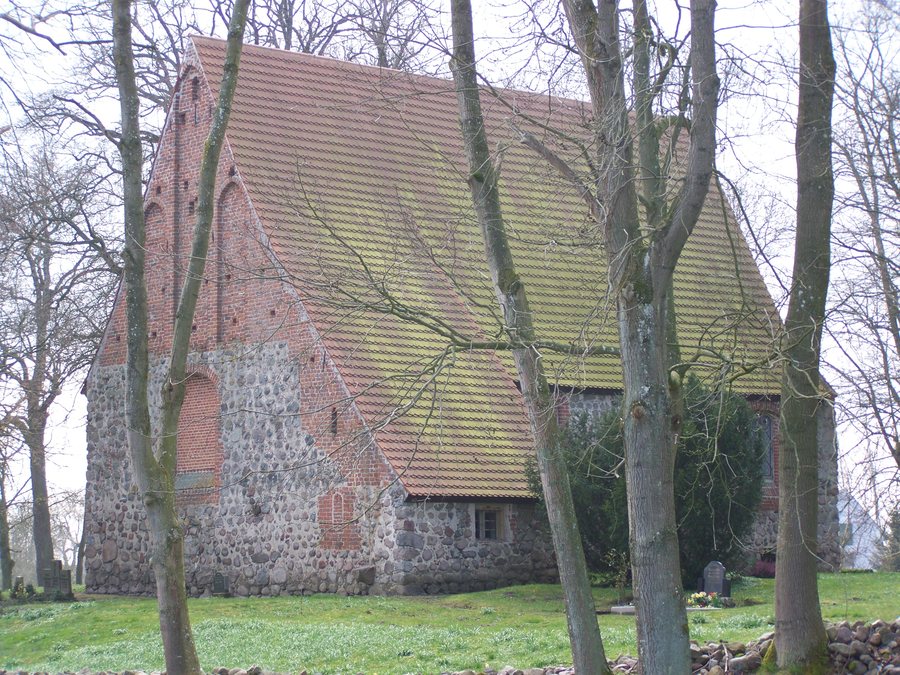
St. Mary’s Church in Drechow
The church has a free-standing bell tower right beside it, which was renovated in 2014/2015. The church building and the separate bell tower are therefore two distinct architectural elements standing side by side. The renovation adds a precisely dated chapter of more recent architectural history to the medieval context of the fieldstone building. Together, the building and its renovation offer different historical points of interest.
Katzenow Manor House in the municipality of Drechow
A second historical perspective is offered by Katzenow Manor House, built in 1885 by Ulrich Count von Behr-Negendank in a stately style. It is located in Katzenow, a district of the municipality of Drechow; the church, by contrast, is in Drechow itself. A church building dating to the medieval period and a manor house with a specific year of construction thus offer different historical points of interest, without being located in the same place. This distinction can help with trip planning if you are specifically interested in the settlement of Drechow.
Vorpommern-Rügen: Culture and landscape on a larger scale
In the wider destination of Vorpommern-Rügen, the focus expands from local buildings to the culture and landscape of the district. There are an estimated 60 or so museums there. The old town of the Hanseatic city of Stralsund is also part of the UNESCO World Heritage site “Historic Centres of Stralsund and Wismar.” On Rügen, the beech forests in Jasmund National Park are part of the World Heritage site “Ancient and Primeval Beech Forests of the Carpathians and Other Regions of Europe.” These examples bring together urban history and woodland landscapes as distinct cultural and scenic interests within the wider region.
The region’s geography also includes the Fischland-Darß-Zingst peninsula chain, as well as the island of Rügen and the offshore islands of Hiddensee and Ummanz. They all belong to the district of Vorpommern-Rügen. This offers a broad geographical context for planning a trip, with the peninsula chain and islands serving as distinct regional points of interest alongside Drechow’s local history.
One cultural attraction in the district is the gallery at the monastery in Ribnitz-Damgarten. It mainly exhibits contemporary regional art, as well as a permanent exhibition of prints by Lyonel Feininger. The art collection of the district of Vorpommern-Rügen is preserved, maintained and administered there. It comprises around 500 works of painting, graphic art, sculpture, ceramics, silk painting and textile design, dating from the late 19th century to the present day. Visitors can see changing exhibitions featuring works from the collection; check the current visitor arrangements before your visit. The district’s cultural offerings thus range from architectural history to art collections and changing exhibitions.
Discover more destinations: Deyelsdorf, Eixen, Grammendorf, Bad Sülze, Tribsees, Gransebieth, Dettmannsdorf, Lindholz.
See the wider travel overview: Amt Recknitz-Trebeltal.

