
Przerwanki: Lake, Sapina and historic buildings
Accommodation in Przerwanki
The Harcerska Baza Obozowa Cyranka is located in Przerwanki on the north shore of Lake Gołdapiwo, in a pine and spruce forest. The lakeshore and forest define this location; the lake is subject to a quiet-zone restriction. If you are looking for accommodation in Przerwanki, it helps to distinguish between the local themes: the waterway, cycling route and history of the buildings each point to different aspects of the place. Routes and history come together at the lock, while the forest and lake provide the landscape setting.
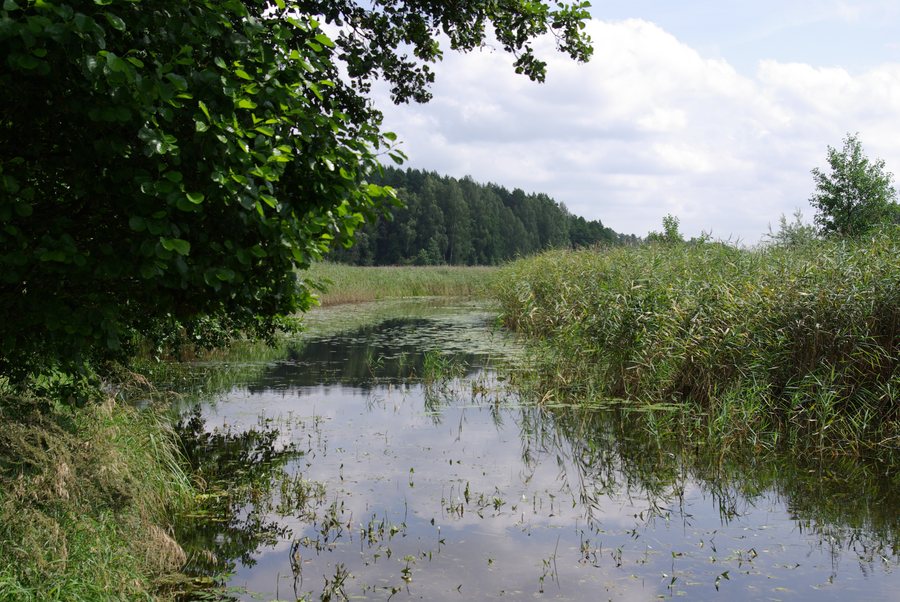
The restriction applies to the lake; by contrast, passing through the lock is part of the kayaking route on the Sapina. This distinction separates two different connections to the water.
The Harcerska Baza Obozowa Cyranka is also located in the pine and spruce forest on the north shore of the lake. It is created by scouts for scouts, bringing a distinct, explicitly scout-related element to Przerwanki.
Kayaking route and cycling route
The kayaking route on the Sapina passes through the active Przerwanki lock. The lock was built in 1910 and is a single-chamber lock. This designation classifies the structure by its single chamber: it describes the design, while 1910 gives the year it was built. For your planning, passing through the lock is the specific connection between the Sapina and the lock. Check the lock’s current operating conditions before kayaking.
The Wokół Jeziora Gołdapiwo cycling route passes the single-chamber lock in Przerwanki. This makes the difference between the two routes clear: the kayaking route passes through the lock, while the cycling route passes by it. If you are setting off by bike, check current route conditions beforehand.
Lock, bunkers and architectural history
Bunkers from the First and Second World Wars are located right next to the lock on the Sapina. Thus, this site brings together a hydraulic structure built in 1910 and bunkers associated with two different wartime periods. The construction date places the lock before the wars with which the bunkers are associated. This makes it possible to consider water engineering and wartime remains as distinct historical connections.
The Rybaczówka adds another type of building. Located on the left bank of the Sapina, it is partly built of brick and partly of wood, and has been preserved in its historic form. As an example of earlier construction, it has a different focus from the lock and bunkers: here, the subject is the construction of a single building. Brickwork and wood are the two materials; its preserved historic form is also part of its description. The Rybaczówka thus complements the view of technical infrastructure and wartime remains with an example of traditional construction. Two location details are relevant for orientation: the bunkers are next to the lock, and the Rybaczówka is on the left bank of the Sapina.
Discover more destinations: Kolonia Pozezdrze, Łabapa, Wesołowo, Sztynort, Kolonia Rybacka, Budry, Sobiechy, Jakunówko.
For the main travel overview: Węgorzewski.

