
Sobiechy – Landscape and Village History
Accommodation in Sobiechy
Sobiechy can be understood through its landscape and village history. The Węgorapa landscape provides the broader context; brick school buildings, a former inn, and an archaeological project highlight specific local themes. This brings together a geographical setting and various traces of cultural history.
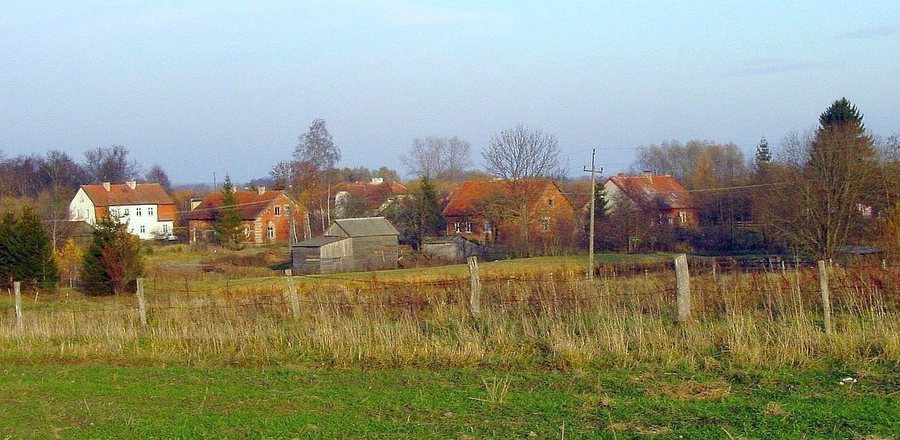
Landscape and River
The Węgorapa landscape forms a natural continuation of the depression of the Great Masurian Lakes; the Węgorapa flows near the village. The geographical points of reference therefore range from the broader landscape to the nearby river. This scale may be important when choosing a destination: Sobiechy can be understood both in terms of its place in the landscape and its proximity to the water. The depression provides the broader setting, while the river offers a specific local connection.
School Buildings and Archaeological Heritage
A group of brick school buildings dating from the interwar period stands in Sobiechy. It comprises a school and an outbuilding. The two components can be seen as a connected group of buildings, while retaining their different functions: education and economic use. Its interwar dating places the ensemble in a historical period; the brickwork and the two building types give it architectural definition. For architectural history, both the period and the different functions of the individual buildings are relevant.
The “Garnki na tatulowym polu” project adds an archaeological theme to the architecture. It was carried out in Sobiechy in 2004 to introduce pupils from the local primary school to various aspects of archaeological heritage. Unlike the school buildings, it is not primarily about the use of a building, but about introducing young people to archaeological heritage. The village’s history thus brings together a built ensemble and a specific cultural heritage education initiative.
A Former Inn
Another historical trace is Augusta Sperling’s former inn. It stands just after the entrance to the village when arriving from Pawłowo. This directional detail pinpoints the building’s location in the village, while the term “former inn” records its past function. Compared with the school buildings, it points to another aspect of village life: here, the focus is on the former inn rather than education and economic use. It thus adds another historical use to the picture of Sobiechy.
The Węgorapa as a Route Reference
A described kayaking route on the Węgorapa includes Sobiechy and Wężówko. The river thus has two distinct roles: it is part of the village’s geographical setting and also the reference point for a route. This offers a different perspective from the architectural and project history; the kayaking route brings the connection along the waterway to the fore. For planning a themed trip, cultural history and the connection to the water are therefore two different points of interest.
Discover more destinations: Kolonia Rybacka, Kal, Harsz, Pozezdrze, Pawłowo, Kuty, Sztynort, Przystan
For the wider travel overview: Węgorzewski.

