
Born am Darß
Born am Darß lies on the Bodden side of the peninsula, south of the extensive Darß Forest. The village, forest and West Beach are different destinations for excursions: Start in the lanes by the water, then choose a marked trail through the national park forest to the coast.
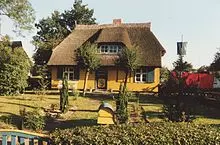 Typisches Haus in Born
Photo: © Wikimedia / MoSchle CC BY-SA 3.0
Born am Darß at a glance
- Location: Born lies on the Koppelstrom and the Bodstedter Bodden; it is not a Baltic Sea beach resort.
- Darß Forest: More than 5,000 hectares of national park forest lie west and north of the village; its network of trails is open to hikers, cyclists, riders and horse-drawn carriages.
- West Beach: The beach can be reached through the forest. The operator of the Born-Ibenhorst youth hostel lists the distance to West Beach as around 2.5 kilometres and to the Bodden as 3.5 kilometres.
- Museum: The “Ferdinand von Raesfeld” Forestry and Hunting Museum is located at Chausseestraße 64, within the complex of the Old Chief Forester’s Lodge.
- National park: In core zones, visitors must stay on the marked paths; dogs must be kept on a lead, and wildlife and plants must be left undisturbed.
Village and Bodden: a walk through Born
Born stretches for about four and a half kilometres from the Saaler Bodden in the west to the Koppelstrom along its southern shore. Thatched houses, decorated doors and gables recall the village’s past as a fishing and farming community. Rather than seeing Born as a single harbour settlement, it is worth strolling along the village streets and taking a detour down to the water. The small harbour and the open expanse of the Bodden offer a peaceful contrast to the Baltic coast and make a good starting point for boat trips or a bike ride.
Reeds, low meadows and shallow water shape the view along the Bodden. Paths lead from Born along the Bodden side and to neighbouring villages. If you want to combine the village, harbour and West Beach in one day, bear the distances in mind: the Baltic coast lies beyond the forest, so reaching it involves a different route from the short paths along the Bodden. A walk through part of the village offers insight into its architecture and location before the excursion continues into the wider landscape.
Darß Forest and West Beach: two connected but distinct destinations
The Darß Forest is part of the Western Pomerania Lagoon Area National Park and covers more than 5,000 hectares. It extends south towards Ahrenshoop and north to Darßer Ort, with its lighthouse and Natureum. There are no settlements within the forest. A dense network of hiking, cycling and riding trails, as well as carriage routes, runs through it. The best route therefore depends on your destination: West Beach is a coastal excursion through the forest, while Darßer Ort is a longer journey to the northern tip of the peninsula.
The Born-Ibenhorst youth hostel is a useful landmark on the forest side. It is about 3.4 kilometres from the village centre, and the Born-Ibenhorst bus stop is around 500 metres away. The youth hostel association lists the property, which has a campsite, as being about 2.5 kilometres from West Beach and 3.5 kilometres from the Bodden. These distances start at Ibenhorst, not in the centre of Born. For 2026, the youth hostel season is listed as running from 27 March to 31 October.
West Beach is a natural coastline that is constantly changing. Waves and currents erode sand from the western shore and carry it north; at Darßer Ort, the material is deposited, forming new spits. As a result, the headland can grow while the forest at West Beach retreats. This is part of the natural dynamics of the coast, not a sign of a built-up promenade. The wind-shaped trees and long, open beach make this route different from an ordinary walk along a seaside resort beach.
In the national park, trails also help protect breeding, resting and dune habitats. In core zones, visitors must stay on the marked paths, and dogs must be kept on a lead. Fires and overnight stays outside designated sites are prohibited. Local signposts show which trails are open to cyclists and which are for pedestrians only. Roots, loose sand and fallen branches are all part of the natural forest floor.
At Darßer Ort, a circular trail runs partly along boardwalks through marshy terrain, with two viewpoints along the way. The destination offers more than just the lighthouse: it provides access to the young landscape at the northern tip and its coastal formations. Born is a starting point in the southern part of the region, but visiting Darßer Ort requires more time than a trip to the nearer West Beach. A bicycle gives you more route options, while the boardwalk loop is designed for walking.
“Ferdinand von Raesfeld” Forestry and Hunting Museum
The “Ferdinand von Raesfeld” Forestry and Hunting Museum is located at Chausseestraße 64. It tells the story of the Old Chief Forester’s Lodge and forestry on the Darß peninsula. Ferdinand von Raesfeld managed the Darß forestry district from 1891 to 1913; his work and the cultural history of the building complex are a major focus. Exhibits include historical documents, forestry and hunting objects, and animal specimens. Audio and media stations complement the exhibition with forest sounds, accounts of working life and conversations with people whose lives were connected with the forest.
The museum reopened in 2024 after the former stable was renovated. It adds the history of human use of the area to a walk in the forest. The village is also home to the Fishermen’s Church on Kirchweg. Built in 1935, it features carved figures in the chancel and an altarpiece by Bernhard Hopp. The barrel-vaulted ceiling gives the small interior excellent acoustics, and the church is used for concerts. The history of forestry and the history of the fishing village therefore make two distinct cultural stops that can be combined.
Including Born in a trip around the peninsula
Born is particularly well suited as a starting point for exploring the forest and the Bodden. Nearby Wieck is also a village on the Bodstedter Bodden and is home to the Darßer Arche, with its exhibition about the national park. The neighbouring seaside resort of Ahrenshoop offers the Hohe Ufer cliffs and its own artistic heritage. Wustrow on the Fischland combines a Baltic Sea beach with a Bodden harbour; Dierhagen lies at the southern gateway to the peninsula, with districts spread between the sea and the Bodden.
If you are looking for accommodation, Wieck am Darß is a nearby alternative on the Bodden side. Wieck offers another base for a stay between the Bodden and the national park. Born itself has three distinct points of reference—the harbour, village streets and Ibenhorst—which can shape your day’s plans depending on the route you want to take.
Frequently asked questions about Born
Can you reach West Beach from Born?
Yes, the trails lead through the Darß Forest. The operator lists the distance from the youth hostel in Born-Ibenhorst to West Beach as about 2.5 kilometres and to the Bodden as 3.5 kilometres; these figures are from Ibenhorst, not the village centre.
What is the difference between Born and Ibenhorst?
Born is the village on the Bodden side of the Darß. Ibenhorst is farther into the forest and refers to the location of the youth hostel and its campsite within the national park.
Which museum is in Born?
The “Ferdinand von Raesfeld” Forestry and Hunting Museum at Chausseestraße 64 documents the history of the Old Chief Forester’s Lodge and the forestry and hunting history of the Darß. The Fishermen’s Church is another cultural stop in the village.
