
Wustrow on the Fischland peninsula
The Baltic Sea resort of Wustrow on the Fischland peninsula lies on a narrow strip of land between the open Baltic Sea and the Saaler Bodden lagoon. A visit can be divided neatly into two sides: the pier, beach and coastal forest by the sea, and the church, Fischlandhaus and harbor by the lagoon.
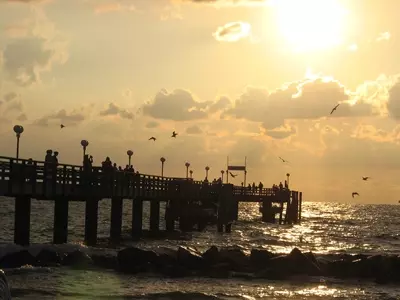 Seebrücke Wustrow
Photo: © Freya Meschede / pixelio.de
Wustrow on the Fischland peninsula: key facts
- Location: This Baltic Sea resort is on the Fischland peninsula; it is not the other Wustrow near Rerik, which has the same name.
- Pier: The current pier is 240 meters long, accessible to visitors with limited mobility, and offers views along the coast.
- Church: The Fischland Church has an observation gallery 18 meters above the ground and displays ship models from the region’s seafaring history.
- Bodden harbor: The Fischland harbor is on the western shore of the Saaler Bodden; Zeesboot sailing trips and passenger boat cruises depart from here.
- Culture: The listed Fischlandhaus at Neue Straße 38 houses a library, gallery and events.
Pier, beach and church
The Wustrow pier extends 240 meters into the Baltic Sea. From there, you can look across the beach and cliffs toward Warnemünde; at the entrance to the pier, the sandstone sculpture “Swantewit” recalls the town’s early history. The pier is accessible to visitors with limited mobility and makes for a short stroll without committing to a longer beach walk. Concerts are held at the pier in summer, and the pier festival takes place on the last Sunday in August.
Just a short walk from the beach stands the Fischland Church. Its Gothic baptismal font, made of French limestone, is among its oldest furnishings. Three ship models inside the church commemorate sailors from Wustrow who donated replicas of their vessels. The tower is a prominent landmark visible from far away; its observation gallery is 18 meters above the ground and offers views over the lagoon, land and sea. From here, you can see just how close the Baltic coast and the lagoon shore are to each other, helping you appreciate the narrowness of the peninsula.
The church is more than a historic building: it helps explain why seafaring was part of everyday life on Fischland for so long. The former seafaring school and the captains’ and sailors’ houses also bear witness to the town’s maritime history. The streets are notable for their thatched cottages, old lime-tree avenues and cottage gardens. Neue Straße and the paths leading down to the harbor make a good addition to the beach side for a stroll around town.
Fischlandhaus and local history
The Fischlandhaus at Neue Straße 38 is a listed building with a high-ceilinged central hall, a typical architectural feature of the region. The building, which is about 200 years old, houses a small library and a gallery. The exhibition rooms feature changing works with a regional connection; concerts and readings for adults and children are also held here. This makes the house a fitting cultural stop between the church and the Bodden harbor. It is smaller than a major museum, but offers a direct connection to the town and changing glimpses of its contemporary cultural life.
Wustrow was once an island, until a land connection to the mainland formed at the end of the 14th century. The name is interpreted as “Swante Wustrow,” meaning “Holy Island.” The historic changes to the landscape are easy to follow from the view atop the church tower. The seafaring school was founded in 1846 and shaped Wustrow’s maritime vocational training; maritime training in the town ended in 1992. This history is part of the townscape, but a visit today is not limited to historic buildings: the beach, harbor, galleries and paths along the lagoon each have their own appeal.
Fischland harbor and a Bodden outing
The Fischland harbor is on the western shore of the Saaler Bodden and is clearly distinct from the Baltic Sea side. The focus here is on Zeesboot sailing boats, a sailing school and a stopover for waterway travelers; there is also a fish smokehouse and restaurants around the harbor. The marina has 130 berths, including visitor berths. The harbor is a good starting point for a bike ride or a walk along the shore, and offers a change of scene from waves and beach to the calm waters of the lagoon.
During the season, traditional Zeesboote set off on sailing trips on the lagoon. A trip lasts about an hour and a half; to join, contact the skipper in advance. If you prefer to stay on land, you can take in the boats, church and village of Barnstorf as one maritime panorama from the harbor. The lagoon side is particularly appealing if you’re looking for time on the water or seafaring history; for sandy beaches and expansive sea views, the pier is the better stop.
Wustrow as a stop on the Fischland peninsula
The town lies between several distinct destinations. To the north are Ahrenshoop, with its art museum and cliffs, and Born on the edge of the Darß forest. To the south, Dierhagen marks the entrance to the peninsula from the mainland; to explore the landscape west of the peninsula, visit Graal-Müritz for its pier, rhododendron park and Rostock Heath.
An overnight stay in Wustrow on the Fischland peninsula is a good choice if you’d like to visit the pier in the morning or use Fischland harbor as a starting point for an outing on the lagoon.
Frequently asked questions about Wustrow on the Fischland peninsula
How can you combine the Bodden harbor and the beach?
The Baltic beach and Fischland harbor lie on opposite sides of the narrow peninsula. Wustrow is therefore a good place to experience both the pier and sea and the harbor and lagoon during one stay; the two waterfront areas are distinct destinations within the town.
What can you do at Fischland harbor?
The harbor is a starting point for Zeesboot sailing and lagoon cruises. A Zeesboot trip lasts about an hour and a half; there is also a sailing school, boat rentals and places to eat near the harbor.
What can you see from the church’s observation gallery?
From 18 meters above the ground, you can see the lagoon, the land and the Baltic Sea. The gallery makes it especially easy to appreciate how narrow the Fischland peninsula is here, between the two bodies of water.
