
Dierhagen
Dierhagen lies at the point where the mainland meets the Fischland-Darß-Zingst peninsula and comprises six districts between the Baltic Sea and the Saaler Bodden lagoon. If you want to explore the area beyond the beach, you can combine the Baltic seaside resort, village church and Bodden harbours as separate short stops.
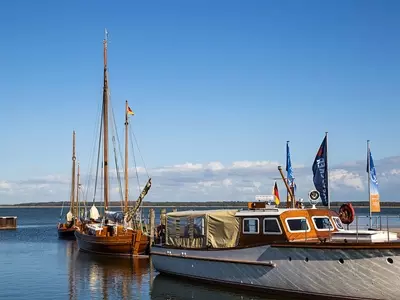 Dierhagen Hafen
Photo: © Wikimedia / Unukorno CC-BY-SA 3.0
Dierhagen at a glance
- Districts: Dierhagen Strand, Dierhagen Dorf, Dierhagen Ost, Dändorf, Neuhaus and Körkwitz Hof.
- Baltic Sea side: Dierhagen Strand lies just behind the sea dyke; from there, the promenade leads to the sandy beach.
- Bodden side: Dierhagen Dorf has a water sports rest stop with 54 berths; Dändorf has a smaller harbour.
- Local character: The brick church and historic captains’ houses define the village and Bodden areas.
- Getting around: The districts are spread across a large area, so choose specific stops for the beach, harbour and village church.
Between the beach access and the sea dyke
Dierhagen Strand is the place to choose for a day by the open sea. The district lies behind the dyke, and the promenade takes you to the fine-sand Baltic beach. In season, the open-air stage in the coastal protection woodland is a nearby cultural attraction in its own right; Dierhagen Strand is also home to the tent cinema and Haus des Gastes, which houses the tourist information office. This makes it easy to combine a beach walk with a visit to the village, without trying to squeeze in the Bodden harbour on the same short outing.
If you’re travelling with children, you can use the beach promenade as a route between your accommodation, the beach access and places to play. The municipality notes that the six districts cover just over 28 square kilometres between the Baltic Sea and the Bodden lagoon. That’s why a beach day works best when you choose a specific access point; if you also want to see the harbour or church, plan a second leg or take a bicycle.
Dierhagen Dorf: church and water sports rest stop
Dierhagen Dorf lies on the Bodden. Its brick church was built to plans by the architect Virck and dates from the mid-19th century. Inside is a model ship of the “Fregatte von Dierhagen 1799” (Dierhagen Frigate 1799); local tradition links it to sailors who hid in the area during the French forced conscriptions. The ship motif reflects the village’s history, as the links between the Bodden, seafaring and fishing remain visible in the villages to this day.
The larger of the two harbours on the Bodden side is the water sports rest stop in Dierhagen Dorf. It has 54 berths, modern sanitary facilities and a boat slipway. For holidaymakers travelling with their own boat, it’s a practical destination; for other visitors, the harbour offers a glimpse of the Bodden side of the village, which is quite different from the open Baltic beach. From early May to late September, the harbour market takes place at Dierhagen Dorf harbour on Tuesdays and Fridays from 9 a.m. to 2 p.m.
Dändorf and its former salt trade
A second harbour is in Dändorf, on the Saaler Bodden. It used to serve as a salt transhipment point; today, it’s a stop for waterway travellers and a starting point for short walks along the shore. Captains’ houses define the village’s character. Walking past the old houses offers a different perspective on Dierhagen from the one you get at the beach: here, the focus is on life on the Bodden, seafaring and the history of a trading post, while the Baltic side is shaped more by the beach and seaside resort life.
In Dändorf, the history house hosts changing exhibitions on the history of the Baltic seaside resort. The church, village harbour and history house make Dierhagen Dorf and Dändorf a peaceful cultural and waterside outing. The resort as a whole covers a large area; the municipality’s maps help you get your bearings among the districts before setting off by bicycle.
Other districts and landscapes
Dierhagen Ost and Neuhaus combine thatched-roof houses with coastal woodland and paths through the hinterland. Neuhaus lies on the northern edge of the Großer Moor, a protected area with diverse wildlife and plant life. Körkwitz Hof offers paths through meadows and reed beds and lies at the transition to the peninsula. If you prefer to stay active, you can combine cycling, hiking or horse riding with a day of swimming; the municipality describes these districts as offering different ways to experience the sea and the Bodden.
As the gateway to the peninsula, Dierhagen makes a good starting point for a Fischland tour. The neighbouring village of Wustrow lies further along Fischland and combines a pier with a Bodden harbour. The artists’ resort of Ahrenshoop offers art museums and the steep coast at Hohes Ufer; further north is Born, on the Bodden and beside the Darß Forest. For a nature break west of the peninsula, you could also include Graal-Müritz, where the pier and rhododendron park are linked to the Rostock Heath.
If you choose Dierhagen as your base, you’ll have both beach and Bodden destinations within the municipality. Accommodation in Dierhagen can be compared according to whether a Baltic beach access, the harbour in Dierhagen Dorf or a quiet district on the Bodden side best suits your travel plans.
Frequently asked questions about Dierhagen
How many districts does Dierhagen have?
The Baltic seaside resort comprises six districts: Dierhagen Strand, Dierhagen Dorf, Dierhagen Ost, Dändorf, Neuhaus and Körkwitz Hof. They lie between the Baltic Sea and the Saaler Bodden and differ considerably in landscape and local character.
Where are the harbours?
Both Dierhagen harbours are on the Bodden side. Dierhagen Dorf has a water sports rest stop with 54 berths; the smaller harbour is in Dändorf, on the Saaler Bodden.
Which district is best for a beach day?
Dierhagen Strand lies just behind the dyke and offers access to the Baltic beach via the promenade. For captains’ houses, local history and the Bodden harbour, Dierhagen Dorf or Dändorf make a better addition to your visit.
