
Göhren
Göhren lies at Rügen’s easternmost point, between two very different stretches of coastline. The Amber Promenade and pier are part of the lively North Beach; beyond the wooded Nordperd headland, a quieter South Beach opens up, with its own nature trail.
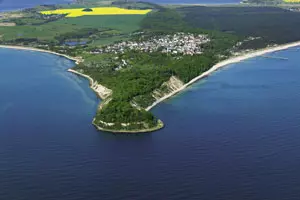 Blick auf Göhren und das Nordperd
Photo: © Kurverwaltung Göhren
Göhren at a glance
- North Beach: the beach promenade, Kurplatz square, playground and 280-metre-long pier are all close together.
- South Beach: more natural, without the beach services available at North Beach.
- Nordperd: a wooded headland, up to 60 metres high, at Rügen’s easternmost point; a cliff-top trail leads through the forest.
- Culture: the local history museum and Rookhus present the everyday history of Göhren and Mönchgut.
North Beach, Kurplatz and the Amber Promenade
North Beach is Göhren’s main bathing and promenade area. The Amber Promenade runs along the sea, with Kurplatz square, a music pavilion, cafés and a playground all close by. The pier at North Beach is 280 metres long and was built in 1992. Excursion boats depart from its end, which is also a good spot for views along the east coast. Here, a day at the beach with children can be combined with a short stroll along the promenade, without having to walk far from the town centre to reach the water.
The promenade continues beyond Göhren towards Baabe and Sellin. It makes a good route for a longer walk or a stretch of cycling; you can start at the beach and stop for a meal later in one of the neighbouring towns. North Beach is connected to the resort centre and offers more facilities than the south side. The pier is more than just a viewpoint: it is a landing stage for boats, whose seasonal routes vary according to destination and timetable.
Across the Nordperd to South Beach
The Nordperd separates the two beaches both geographically and in terms of landscape. The wooded headland rises up to 60 metres above the Baltic Sea and forms Rügen’s easternmost point. A circular cliff-top trail passes through the coastal forest; along the way, there are views over the sea and, on clear days, as far as Greifswalder Oie or Usedom. The woodland is part of the core zone of the Southeast Rügen Biosphere Reserve and has largely been left in its natural state. Please stay on the paths and treat the route as a nature walk rather than simply a way to get from one beach to the other.
South Beach lies at the foot of the headland. It is more natural and does not have the same services as North Beach: there is no lifeguard service, beach chair rental or food and drink. Those seeking peace and a path along the coast will find a different atmosphere here from that of the Amber Promenade. North Beach is more convenient for families who need a playground, amenities or lifeguarded bathing areas; South Beach is better suited to a peaceful stroll.
Depending on where you start, the route across the Nordperd can be planned as a longer cliff-top hike. The beach is not served by a paved promenade, and sturdy footwear is needed for the forest section. At South Beach, a historic salt path also leads down to the coast: the so-called Salt Gorge recalls that a herring saltery stood on the beach in the 19th century and that salt was brought there to process the catch. This path adds a tangible reminder of Göhren’s former coastal economy to the scenic views.
Mönchgut history in town
The local history museum on Strandstraße traces the history of Göhren and the Mönchgut peninsula from the Bronze Age to modern times. The listed half-timbered house was built around 1850 and opened as a museum in 1963. Its exhibits combine everyday history with regional traditions. A visit makes a good addition to a day of beaches and nature, shifting the focus from seaside resort architecture to the lives of local fishermen and farmers.
Rookhus on Thiessower Straße offers a glimpse of the traditional life of Göhren’s fishing farmers in a historic smokehouse. Together with the museum courtyard and the local history museum, it forms a small ensemble that can be combined with a walk around town, including the spa gardens and pier. Opening hours vary by season and from museum to museum; if you have limited time, it makes sense to choose one as your main destination rather than trying to fit several buildings in between beach visits.
Göhren without a car and around the region
The Rasender Roland railway station is close to the town centre. The narrow-gauge railway connects Göhren with Putbus via Baabe, Sellin and Binz; exact routes and seasonal timetables vary. Local buses and routes around Mönchgut offer additional connections, while the local railway from Baabe and Sellin is another option during the summer months. This makes it possible to combine a beach visit and a museum trip without a car.
For a beach walk to Baabe, follow the Amber Promenade west; Sellin also has a pier, as well as a transition from North Beach to the longer South Beach. Further up the east coast, Binz is a larger seaside resort with a Kurhaus and promenade. Putbus-Lauterbach offers a different kind of excursion: Putbus and Lauterbach are known for their neoclassical town history and Bodden harbour.
Accommodation in Göhren is spread between the town centre and the beach. If the pier, North Beach and the local history museum are your main priorities, a central location is convenient. For South Beach, it is important to know the designated access points, such as the Salt Gorge, and the distances involved; the two sides of the coast are not laid out side by side like two stretches of a straight promenade.
Frequently asked questions about Göhren
How long is the pier?
The pier at North Beach is 280 metres long and was built in 1992. It is free to access and also serves as a landing stage for excursion boats.
What is the difference between South Beach and North Beach?
North Beach has a promenade, Kurplatz square, a playground and seasonal beach services. South Beach is more natural and has no comparable facilities.
How do I get to South Beach?
The Salt Gorge is a historic path leading to South Beach. Alternatively, combine your beach visit with the circular cliff-top trail across the wooded Nordperd; this is a longer nature hike.
Which museums are there in Göhren?
The local history museum on Strandstraße focuses on the history of Mönchgut; Rookhus presents the traditional life of the fishing farmers. Opening hours vary by season.
