
Putbus and Lauterbach
Putbus and Lauterbach form two closely connected stops in the south of Rügen: Putbus is known for its Circus, palace park and neoclassical architecture, while Lauterbach is known for its harbour and Bodden lagoon. The protected island of Vilm can only be visited on a guided excursion departing from Lauterbach.
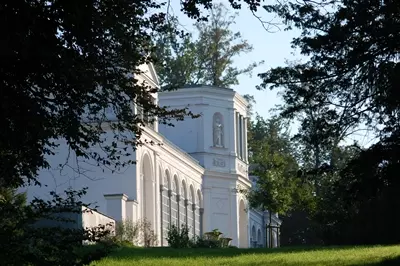 Orangerie
Photo: © Martin Schulz1 / pixelio.de
Quick facts about Putbus, Lauterbach and Vilm
- Putbus: The Circus and its white neoclassical houses form the historic town centre; the palace itself was demolished in the early 1960s.
- Palace park: The freely accessible park brings together culture, walking paths and old trees.
- Lauterbach: The harbour town is part of Putbus; Lauterbach Mole station is served seasonally by the Rasender Roland.
- Vilm Island: Visits are permitted only as part of a pre-booked guided tour. Allow around three hours in total for the boat trip and tour.
The Circus and Putbus, the White City
Prince Wilhelm Malte zu Putbus commissioned plans for a neoclassical residential town from 1810 onwards. The Circus is its most striking square: white houses stand in a circle around an obelisk, and streets lead from the square to the town centre and palace park. The name “White City” refers to the light-coloured façades that still define Putbus today. A stroll around the Circus and along Alleestraße gives you a sense of the town’s design before you continue through the park.
The princely palace no longer stands. It was demolished in the early 1960s, but the palace park has been preserved and is open to the public. The Orangery, Marstall and Residenztheater are located here and can be visited on a walk around the park. Anyone interested in the former residence can see an exhibition about its history in the old smithy. This way, a visit to the park is not a search for a building that no longer exists, but a chance to explore the surviving ensemble.
Putbus is compact enough to explore on foot, with a route that takes in the Circus, the market square and the park. You can start your day in town and then continue to Lauterbach. The narrow-gauge railway stations make the connection especially easy: the Rasender Roland links Putbus and Lauterbach Mole seasonally. It is a convenient option if you want to visit the town centre and harbour without using a car for the short journey.
Lauterbach: harbour and Bodden waterfront
Lauterbach is Putbus’s harbour and seaside resort district on the Greifswalder Bodden. Sailing boats, passenger vessels and the shoreline of the Rügischer Bodden meet at the harbour. The boat to Vilm Island departs from here, so the pier and landing stages are not just places to enjoy the view but also the practical starting point for a nature excursion. If you visit Putbus in the morning, you can combine a walk through the park with a visit to the harbour in the afternoon.
The harbour town can also be reached on the Rasender Roland: get off at Lauterbach Mole station if you are heading to the landing stage. Distances around the harbour are short, and it is easy to go straight from the train to the waterfront. The shore is a good place to take a break before returning to the town centre or continuing towards the coast.
Visit Vilm Island only on a guided tour
Vilm is a strictly protected nature reserve southeast of Lauterbach. Independent walks on the island are not permitted: visitors can only go there as part of a guided excursion by boat from Lauterbach harbour. The tour takes you across Großer Vilm and lasts around two and a half hours; allow about three hours for the round-trip boat journey and tour combined. The walk covers approximately 3.2 kilometres through natural, sometimes rugged terrain.
Numbers are limited to a maximum of 60 visitors per day, and advance booking is required. Bookings are accepted by Reederei Lenz or the harbour café in Lauterbach harbour. Because the terrain is uneven, wheelchairs and prams cannot be accommodated on the excursion; pets are also not allowed on the island. These conditions make a trip to Vilm a planned nature outing rather than a spontaneous stop between two destinations.
For your day’s itinerary, this means planning your town walk around a booked excursion time. Even without a trip to Vilm, Lauterbach is worth a stop at the harbour; you can then enjoy Putbus, the park and the Bodden at a relaxed pace, without having to keep to a set excursion time. Vilm’s natural environment is the reason for the access restrictions, so stay with your group and follow the guided route throughout your visit.
Putbus and Lauterbach as a base for exploring
If you want to see more of southeast Rügen, travel from Lauterbach via Putbus to Binz or continue along the southeastern seaside resorts to Baabe and Göhren. These coastal towns add beaches, piers and promenades to your visit. For a train journey across the island, centrally located Bergen is another option; Putbus itself is the place to explore neoclassical residential history and parkland.
If you are planning to visit Vilm, staying near the harbour is convenient for an early start to the excursion. The town centre is a good choice for visiting the Circus and palace park, while Lauterbach is better suited to those whose main interests are the harbour and boat trips on the Bodden. Accommodation in Lauterbach and Putbus can help you choose a location that fits your itinerary.
Frequently asked questions about Putbus and Lauterbach
Can I visit Vilm Island independently?
No. The island is a strictly protected nature reserve and can only be visited as part of a guided excursion departing from Lauterbach harbour.
How long does the Vilm excursion take?
The guided tour on the island takes around two and a half hours; allow about three hours including the boat trip. The route on Großer Vilm is around 3.2 kilometres long and crosses natural terrain.
How do I get from Putbus to Lauterbach?
The Rasender Roland links Putbus with Lauterbach Mole station seasonally. From there, you can reach the harbour and the landing stage for the Vilm excursion.
What can I see in Putbus if I’m looking for the palace?
The princely palace was demolished in the early 1960s. The palace park, Circus, Orangery, Marstall and Residenztheater preserve parts of the historic ensemble and can be visited on foot.
