
Hammershus Castle Ruins: History and Visiting
Hammershus brings together Bornholm’s history and a striking setting on a rocky plateau on the island’s north coast. Start at the visitor centre with the exhibition, then cross the bridge through Mølledal to the ruins. This gives you a clear sequence for exploring the site’s construction history, outer baileys and views.
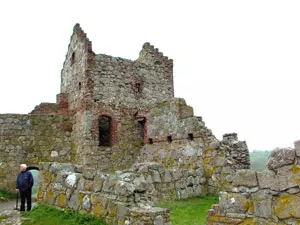 Burgruine Hammershus auf Bornholm
Photo: © Rainer Höll
Hammershus at a glance
- Location: in northern Bornholm near Allinge, on a high rocky ridge above the Baltic Sea.
- Visitor centre: about 200 metres east of the ruins; a bridge crosses Mølledal towards the castle.
- Admission: The ruins and exhibition are free to visit.
- Opening: The castle ruins are open year-round, 24 hours a day. The visitor centre has seasonal opening hours.
- Getting there: via Slotslyngsvej; a bus stops at Hammershus, and the Bornholm Rundt cycling route passes by.
- Parking: Seasonally, 35 DKK for six hours; parking is free outside the fee-charging period.
Visitor centre and route to the ruins
 The visitor centre lies about 200 metres east of the castle. Its exhibition introduces the eventful history of Hammershus, while a restaurant, shop and toilets round out the visit. The route to the castle crosses Mølledal via a bridge. Visiting the exhibition first helps you explore the ruins with the key historical terms and building phases in mind.
In autumn 2026, the centre will be open daily from 10 a.m. to 4 p.m. from 19 October to 1 November. After that, it will be open on Saturdays and Sundays through 13 December, and daily from 10 a.m. to 4 p.m. from 27 to 30 December. The café closes half an hour earlier. The castle ruins remain accessible at all times, regardless of these hours. If visiting on the same day, it is therefore worth distinguishing between the outdoor grounds, which are open year-round, and the indoor facilities, which have seasonal hours.
The address is Slotslyngsvej 9, 3770 Allinge. By car, reach Hammershus via Slotslyngsvej and Langebjergvej. A local bus stops at the site; cyclists can use the signposted Bornholm Rundt route, which passes Hammershus between Rønne and Allinge. Staying in Allinge-Sandvig makes a convenient base for exploring the north coast. The location lets you combine a castle visit with the harbour and coastal paths.
Outer baileys, bridge and inner castle
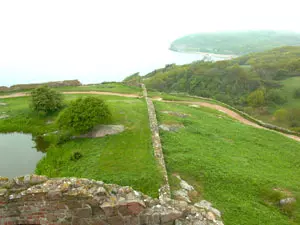
The landward approach led over Slotsbro, a slightly angled bridge that made it harder for attackers to use a battering ram. Beyond it are the outer areas of the castle complex. Three outer baileys—in the north, east and south—were enclosed by curtain walls. Their wall walks and loopholes show that Hammershus was designed as a tiered fortress, not as a single residential tower.
Inside a further curtain wall was the castle courtyard, with buildings used for storage and administration. The central keep provided an additional place of refuge and defence. The keep tower housed the administration, among other functions; later, parts of the complex were also used as a prison. From the grounds, you can follow these zones in order, from the outer entrance through the baileys to the heart of the castle. The rock, sea and valley at the foot of the site complemented the fortifications built by people.
The setting also makes a visit an experience of the landscape: the castle stands high above the coast, with views across the rocks and the Baltic Sea. Allow enough time to explore the individual wall remains and viewpoints. The site is best explored on foot; the centre, bridge and castle form a connected route through the visit.
How the fortress was built and its role changed
The castle’s construction history spans several centuries. According to the Danish Agency for Culture and Palaces, tradition holds that Hammershus was built around 1249 by Archbishop Jacob Erlandsen. The complex was expanded in several building phases and changed shape as it served as a fortress, administrative centre and storehouse. Its position at Bornholm’s northern tip was strategic: from this height, shipping in the Baltic Sea could be monitored.
Control of the castle shifted between the Church and the Crown, as well as Danish, Lübeck and Swedish rulers. These conflicts shaped the island’s history, but the walls also tell of the everyday organisation of a fortified complex: the outer baileys protected the approaches, storehouses held provisions, and the central castle brought administration and defence together. Hammershus remained in use for more than four centuries and was abandoned towards the end of the 17th century. The ruins have been protected since 1822; extensive archaeological work in the 19th century was followed by ongoing conservation. Today, the seasonal parking fee helps fund restoration and the operation of the visitor centre.
You can continue exploring Bornholm from Hammershus: Allinge and Sandvig combine a castle visit with a harbour, a beach cove and coastal paths. For an overview of the island’s landscapes and places to stay, see the Bornholm travel guide. If you are planning another cultural stop after visiting the north coast, the Bornholm Art Museum by the Helligdom cliffs offers a different perspective on the island’s history and culture. Another island excursion takes you to Christiansø, which can be planned as a day trip from Bornholm.
Frequently asked questions about Hammershus
Are the castle ruins open year-round?
Yes. The outdoor grounds of the castle ruins are accessible year-round, 24 hours a day. The visitor centre, including the exhibition, restaurant and shop, opens seasonally and has its own opening hours.
How do you get from the visitor centre to the castle?
The visitor centre lies about 200 metres east of the ruins. A bridge crosses Mølledal towards Hammershus; from there, the route continues through the outer baileys to the inner part of the castle.
How much does a visit cost?
Admission to the ruins and exhibition is free. Parking costs 35 DKK for six hours during the seasonal fee-charging period; outside that period, parking is free.
What history can you discover on site?
The route takes you through the tiered complex of Slotsbro, three outer baileys, curtain walls and the keep. The structures show how the terrain and fortifications worked together to shape access to and defence of the site.
