
Jasmund National Park
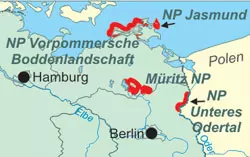
At just 30 square kilometres, Germany’s smallest national park, established in 1990, is located on Germany’s largest island, Rügen. It encompasses one of the island’s most fascinating areas: the chalk cliffs on the Jasmund Peninsula, including the 116-metre-high Königsstuhl, one of the most popular destinations for visitors on a holiday on Germany’s Baltic coast. The park also includes the adjacent woodland, with its ancient stands of European beech, some of which had already been protected, and 500 hectares of offshore Baltic Sea. The spectacular chalk cliffs stretch for about 12 kilometres from Sassnitz to Lohme. A hike from Sassnitz along the foot of the chalk cliffs to the Königsstuhl (about eight kilometres) is an unforgettable experience on an active holiday on Rügen. There are two places along the way where you can climb up and cut the hike short. The direct ascent to the Königsstuhl via steep, winding steps is currently closed, and reopening the staircase remains controversial. The return route along the clifftop trail offers unforgettable views of the Baltic Sea and leads through ancient woodland. Before setting out, however, be sure to visit the National Park Centre, whose exhibition offers a comprehensive insight into the natural world and the geological history of Rügen.
 The chalk cliffs date back 70 million years. They are not only the most popular destination for visitors on a Baltic coast holiday on Rügen, but have also long been a sought-after subject of study for geologists and archaeologists. Even casual visitors can find plenty of fossils there, such as “chicken gods” (stones with holes in them) and fossilised prehistoric marine animals. The path often crosses rough scree. Every year, the Baltic Sea claims another piece of the cliff; as recently as 2005, large sections of the famous Wissower Klinken collapsed. They had once served as a subject for Caspar David Friedrich. In recent years, hikers have been warned more frequently about the dangers: especially after prolonged rain, parts of the cliff can collapse without warning onto the narrow strip of coast below, which is also barely passable during the winter months. The village of Lohme also faces the threat of rockfalls: its newly built harbour became unusable several years ago after a landslide.
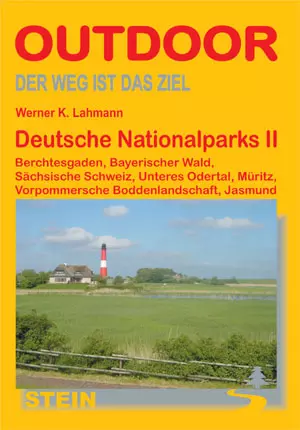 Werner K. Lahmann’s little guidebook not only provides an overview of Jasmund National Park; alongside a general map, it also includes plenty of practical advice on how to get there, places to visit, hiking routes with distances, accommodation and places to eat. In this way, a visit to the national park can also become part of an eventful active holiday on the island of Rügen.
Information:
Werner K. Lahmann
German National Parks II
OutdoorHandbuch, Vol. 268
Conrad Stein Verlag, 2009
€12.90 / CHF 22.90
137 pages, 34 colour illustrations
8 colour map sketches, 1 colour overview map
Format: 16.5 x 11.5 cm
ISBN 978-3-86686-268-5
Information about Conrad Stein Verlag
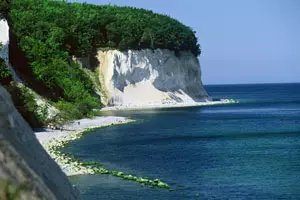 Kreideküste im Nationalpark Jasmund
Photo: Nationalpark-Zentrum Königsstuhl
Kreideküste im Nationalpark Jasmund
Photo: Nationalpark-Zentrum Königsstuhl
