
What is …? Baltic Sea terms
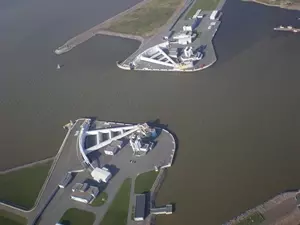 Sperrwerk über den Finnischen Meerbusen vor St. Petersburg
Photo: © Wikimedia / Ssr CC BY-SA 3.0
Baltic Sea terms at a glance
The Baltic Sea can be discovered through more than just places and attractions. Its vocabulary also tells the story of how coastal towns developed, how people spend time at the beach, and what forces shape the sea. This glossary brings together four recurring themes: the architecture of historic seaside resorts, the beach chair as part of bathing culture, amber as fossilized resin, and storm surges as a distinctive coastal event. Each term offers its own perspective on history, nature, or travel planning.
The individual explanations are intended as brief introductions. When looking at a building along the promenade, you can look out for towers, verandas, and gables. On the beach, the beach chair is a familiar part of the holiday scene. Amber connects geological time spans with the cultural history of the Baltic region. A storm surge, meanwhile, describes how wind and water levels affect the coastline. The linked articles explore all four topics in greater depth, with examples and references to specific places.
Spa architecture: villas and promenades
Spa architecture is mainly associated with villas and public buildings constructed during the rise of seaside resorts in the 19th and early 20th centuries. The term does not refer to a single, clearly defined architectural style. Instead, these buildings draw on features from different movements: classical columns, tall windows, bay windows, turrets, gables, and often glazed verandas. These projecting structures extend the living space and provide views of the promenade and sea. What is characteristic is the interplay of façades along a street or seaside promenade, not any single prescribed architectural feature.
Some of the most striking ensembles can be found in the seaside resorts of Usedom and Rügen, as well as in Heiligendamm and Kühlungsborn. The article Spa architecture on the Baltic Sea explains typical design features and gives examples from across the region. On a walk, you can look out for individual façade details while also seeing how villas, hotels, and promenades come together to shape a townscape.
Beach chair: wind shelter and beach furniture
A beach chair is a movable seat with side panels, a canopy, and an adjustable backrest. Its woven shell offers protection from the wind and direct sunlight, while fold-out footrests and trays make time at the beach more comfortable. In 1882, Rostock basket maker Wilhelm Bartelmann made an early version of today’s beach chair for a customer seeking shelter from the wind on the beach. What began as a single piece of seating developed into a widespread beach furniture tradition; on many coastlines, beach chairs are rented out seasonally.
Designs vary in width and seating capacity, among other things: single-seater, two-seater, and larger models line the beach. At holiday resorts, beach chairs are often available at numbered rental spots, which can be chosen according to location and season. The article The beach chair introduces the history and development of this coastal fixture. It also helps explain the difference between a privately owned beach chair and the seasonal rentals available on public beaches.
Amber: fossilized resin on the Baltic coast
Amber is tree resin that has hardened over geological time spans. Baltic amber formed from the resins of ancient conifers; tiny plant remains or insects can be trapped inside it. Its colors range from pale yellow and honey-colored to darker shades. Used as jewelry and a material, amber has been part of the cultural history of the southeastern Baltic region. Its origins in ancient resins and its possible inclusions make each piece a record of habitats from the distant past.
The article Amber on the Baltic coast introduces the material’s formation and regional museum collections. The German Amber Museum in Ribnitz-Damgarten is dedicated to the natural and cultural history of amber; other exhibitions around the Baltic region display jewelry, crafts, and historic uses. Amber can thus be understood both as a geological material and as a cultural motif that has been present in coastal communities for generations.
Storm surges: water levels in the Baltic Sea
A storm surge is an exceptionally high water level caused when persistent winds push water into particular coastal areas or pile it up there. The Baltic Sea is a largely enclosed inland sea with only a narrow connection to the North Sea; water-level fluctuations are caused, among other things, by wind, air pressure, and the exchange of water between its basins. Regular astronomical tides are much smaller along many Baltic coasts than along the North Sea. As a result, weather conditions—not a clearly visible daily tidal cycle—often determine water levels on beaches and in harbors.
Historic floods have shaped coastal towns, islands, and protective structures. The article Storm surges on the Baltic Sea explains the term and provides a historical overview. The subject is also visible to travelers as they explore a town: dikes, dunes, storm-surge barriers, and flood-resilient waterfronts are part of many coastal landscapes. A walk along the promenade can therefore bring architecture, coastal protection, and nature observation together.
Connect terms with specific places
The four themes can be linked on a trip. In Rügen’s seaside resorts, villas and promenades are often just a few steps from the beach, where beach chairs are part of the seasonal bathing scene. After unsettled weather, the strandline changes, drawing attention to natural finds washed ashore. On exposed stretches of coast, the shape of dunes, dikes, and coastal paths is particularly easy to see. The island guide Rügen helps you find your way among the different coastal towns. If you are looking for a base in the southeast of the island, you can include Göhren in your travel plans, with its beach, high cliffs, and local paths.
A practical order for a coastal walk is simple: first, take in the buildings and paths in town; then notice the seasonal beach facilities and natural traces along the shore; and finally, consider the coastal landscape as a whole. The terms in this glossary help you describe what you see more precisely and then explore the articles on architecture, beach furniture, geology, and flooding in greater depth.
Frequently asked questions about Baltic Sea terms
Is spa architecture a distinct architectural style?
The term describes a regional combination of different architectural features. Columns, verandas, bay windows, and gables are common, but they do not make up a rigid set of stylistic rules.
What makes amber geologically special?
Amber is fossilized resin, so it is not a mineral. Sometimes it preserves inclusions of plants or insects, offering a glimpse into habitats from the past.
How does a storm surge differ from the daily tide?
Storm surges are mainly caused by specific weather conditions involving strong winds and changing water levels. Astronomical tides are comparatively small in many parts of the Baltic Sea.
