
Baltic Sea Seaside Resort Architecture
Most seaside resort villas date from around the turn of the previous century, when bathing and spa holidays on the Baltic Sea were growing increasingly popular. Since 1990, they have undergone extensive renovation. Where preservation was no longer possible, new villas were built in the style of seaside resort architecture. Strictly speaking, seaside resort architecture is not an independent architectural style. Instead, numerous elements from Neoclassical and Art Nouveau architecture were adopted and blended into original designs. The seaside resort villas are usually two to four storeys high and built of solid materials, less often of wood, but always adorned with elaborate wooden porches and decorative elements. They are often situated directly along the promenade. Depending on the space available, they stand close together or are surrounded by large parks. A recurring feature is the glazed balconies and verandas, which allow holidaymakers to enjoy views of the dunes and the Baltic Sea while also protecting them from wind and weather. Other common features drawn from classical architecture include columns or pilasters, expansive arched windows or rectangular glass elements, avant-corps, towers and elaborate gables.
Visitors to the Baltic coast will find particularly beautiful ensembles of seaside resort architecture on the island of Usedom, on the island of Rügen, in the seaside health resort of Heiligendamm, in Bad Doberan, in the Baltic resort of Kühlungsborn and in the Baltic Sea health resort of Graal-Müritz.
On the Baltic Sea island of Usedom, numerous villas in the seaside resort style line the promenades in the resorts of Zinnowitz, Bansin, Heringsdorf and Ahlbeck . The finest view of these ensembles can be found on Bansin’s Bergstrasse, where white villas stand close together. Many resort villas surrounded by large parks stretch between the seaside health resorts of Bansin and Heringsdorf. Most were built by influential businesspeople at the end of the 19th century. Even then, Usedom was known as “Berlin’s bathtub” and attracted many affluent Berlin families seeking a summer retreat. While white predominates in Bansin, some of the façades along the beach promenade are vibrantly coloured.
The finest example of seaside resort architecture on Usedom—and also the island’s landmark—is probably the pier in Ahlbeck. This historic structure dates back to 1882. Despite numerous restorations and additions, the original character of Ahlbeck Pier has been preserved to this day.
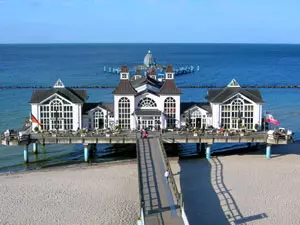 On the Baltic Sea island of Rügen, holidaymakers can admire seaside resort architecture particularly in the Baltic resorts of Binz, Sellin and Göhren, though buildings in this style can also be found in other seaside resorts. The Kurhaus in Binz is an impressive example of seaside resort architecture. This white Neoclassical building is adorned with numerous towers, columns and reliefs, and now houses an upscale hotel. The pier in the Baltic resort of Sellin is probably the finest and most photographed example of seaside resort architecture on Rügen. The white building with its dark roof is decorated with two large connected towers, expansive windows offering views of the Baltic Sea, and numerous triangular gables. Sellin Pier dates back to 1906, but unfortunately none of the original structure remains. The current building opened in 1998.
Seaside resort architecture in Heiligendamm and Bad Doberan
The seaside health resort of Heiligendamm is part of Bad Doberan and is considered Germany’s oldest seaside resort. In 1793, Duke Friedrich Franz I of Mecklenburg-Schwerin had the first bathing house on the German coast built here. The therapeutic effects of seawater were affordable mainly to wealthy holidaymakers. Numerous villas in the seaside resort style soon sprang up. The predominance of white façades, with their Neoclassical and Art Nouveau features, earned Heiligendamm the nickname “White Town by the Sea”. From 1996 onwards, many of the resort villas underwent extensive renovation. Today, the villas along the beach promenade house a luxury hotel.
 Seaside resort architecture in Kühlungsborn
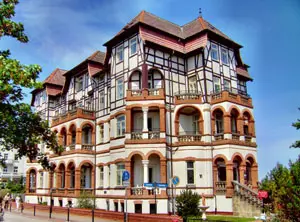
Until the end of the 19th century, the Baltic resort of Kühlungsborn consisted of three small villages. Visitors with an interest in architecture can discover some remarkable examples of seaside resort architecture in Kühlungsborn. While individual villas with just a few apartments predominate on Usedom, Kühlungsborn has larger buildings, most of which house hotels or spa facilities. Unfortunately, little was done to maintain the villas after the Second World War, and they slowly fell into disrepair over the decades. After the political reunification, numerous resort villas were extensively renovated and now accommodate hotels, guesthouses and holiday apartments. Some villas were no longer worth renovating. They were demolished and replaced with new buildings that feature the characteristic elements of seaside resort architecture.
Further information and photos of seaside resort architecture on the Baltic coast of Mecklenburg-Western Pomerania, particularly on the islands of Usedom and Rügen, can be found on www.usedom-exclusiv.de.
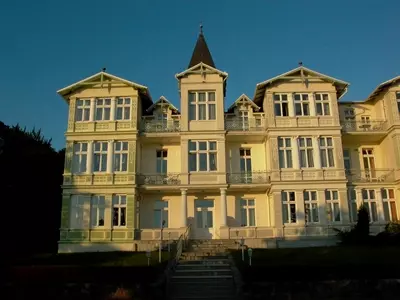 Strandvilla in Zinnowitz
Photo: © nordlicht verlag
Strandvilla in Zinnowitz
Photo: © nordlicht verlag
