
Amber
Amber and the Baltic Sea are almost synonymous. Who doesn’t think of the many solitary amber hunters along the Baltic coast, especially after or during a sea wind? The mystery of the Amber Room also comes to mind, which disappeared in the final weeks of the Second World War and has never been found. Amber still holds a mystical allure today. Its extraordinary variety of colors, shapes and sizes, the possibility of inclusions and their mysterious origins all contribute to the magic of a material whose origins are, however, fairly easy to explain.
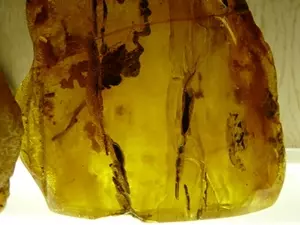 Amber
Photo: © Dieter Schütz / pixelio.de
Amber
Photo: © Dieter Schütz / pixelio.de
How Baltic amber formed
Amber is fossilized resin with properties similar to those of stone. The Ancient Greek name for amber, elektron, refers to its electrostatic properties. Historically, amber was used in the first experiments with static electricity.
The resins come from different plant species, which determine their precise appearance. Inclusions in the form of insects, trapped and preserved in drops of resin, are of great scientific value.
Amber deposits
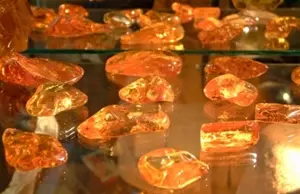 The southeastern Baltic region, the Baltic states and the Sambian Peninsula between the Vistula Lagoon and the Curonian Lagoon are considered to be an area of major amber deposits in Europe. Amber is still mined there commercially today.
But the most romantic way to find amber is to search for it on the beach. Experts know that amber is most often found among silt, branches and other objects washed ashore. The “Amber Spas” owe their name to a small amber mine and, above all, to the many amber hunters on the beach. The Usedom seaside resorts of Zempin, Koserow, Loddin-Kölpinsee and Ückeritz market themselves together under this name.
Amber museums
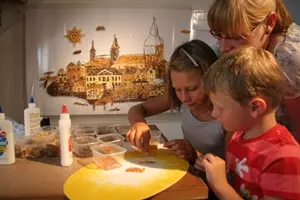 Museums specializing in amber or featuring it in their collections are common along the Baltic coast. There are numerous such museums in towns throughout the Baltic states in particular. In Gdańsk, there is a small street made up almost entirely of little amber shops. Amber jewelry has been documented for more than 10,000 years. Major, well-known amber museums can be found in Palanga in Lithuania, in Kaliningrad, in Gdańsk, and at the German Amber Museum in Ribnitz-Damgarten. Smaller amber exhibitions can be found in Sellin on Rügen and in Jarosławiec in Poland.
