
Baltic Sea Lighthouses
Baltic Sea lighthouses combine coastal navigation with architectural and technological history. Three distinct examples provide a revealing overview: the historic towers at Cape Arkona, the lighthouse in Travemünde, and the still-operational beacon at Darßer Ort.
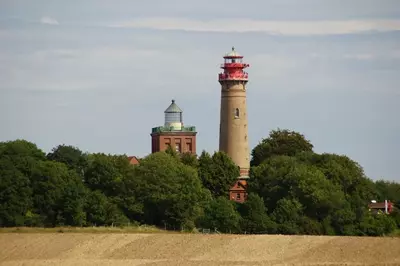 Leuchttürme am Kap Arkona auf Rügen
Photo: © pixabay.com panusus CC0
Baltic Sea lighthouse facts
- The smaller Schinkel Tower at Cape Arkona was first illuminated in 1827.
- The larger lighthouse at Cape Arkona began operating in 1905.
- The present-day Travemünde lighthouse dates back to 1539.
- Darßer Ort still serves as a navigational aid and stands beside the NATUREUM.
- Today, the historic use of some towers continues in the form of museums.
Cape Arkona: two towers from different building periods
The smaller of the two original towers at Cape Arkona is the Schinkel Tower. Its foundation stone was laid in 1826, and its beacon was first put into operation on December 10, 1827. When the larger tower began operating in 1905, the Schinkel Tower ceased service on April 1 of that year. The Cape Arkona tourism association gives its height as 22.45 meters, with a platform 15.55 meters above the ground. The building thus documents an earlier generation of coastal lighting.
The larger lighthouse began operating in 1905. The local tourism website describes it as 35 meters tall; including the height of the cliff, its light is 75 meters above sea level. It also gives a nominal range of 22 nautical miles and a light characteristic of three flashes repeated every 17.1 seconds.
Travemünde and Darßer Ort
The Travemünde lighthouse combines a long architectural history with a new role as a museum. The first mention of a lighthouse in Travemünde dates to around 1330; the present tower was built by Dutch masons in 1539. Following a fire, it was modernized in 1827, and its light was electrified in 1903. In 1922, the tower was listed as a technical monument of cultural heritage. Its light was extinguished in 1972 because the Maritim Hotel obstructed the view. Following restoration in 2003 and 2004, the 31-meter-high building became a maritime museum featuring historic lighthouse technology.
Construction at Darßer Ort began in 1848, and the light went into operation on January 1, 1849. Today, the 35-meter-high tower is still in operation and warns ships of the Darß Shoal. It has been controlled remotely by radio since 1978. The neighboring NATUREUM has been run by the German Oceanographic Museum since 1991. The site therefore remains both part of maritime navigation and a starting point for learning about coastal and marine nature.
Individual lighthouses along the coast
More coastal destinations
Other island and seaside resort destinations on the Baltic Sea include: Hiddensee, Warnemünde, Kühlungsborn, Rügen, Świnoujście and Usedom.
For a stay on Rügen, accommodation in Binz makes a convenient base on the island’s east coast.
Frequently asked questions about Baltic Sea lighthouses
Which lighthouses are now used as museums?
The Travemünde tower houses a maritime museum with historic lighthouse technology. At Darßer Ort, the NATUREUM complements the still-operational lighthouse with a natural history exhibition. These two examples show different ways of connecting technological history with learning today.
