
Ferry Services on the Baltic Sea
Ferry services on the Baltic Sea build on the close historic ties between the countries bordering the sea. The first of the many ferry routes across the Baltic Sea was the route from Sassnitz (Rügen Island) to Trelleborg in southern Sweden, which opened in 1909 as the so-called “Royal Line.” Ferry routes range from just a few kilometres across the Øresund, from Helsingborg (Sweden) to Helsingør (Denmark), to several hundred kilometres from Travemünde to the Baltic States or from Kiel to Oslo.
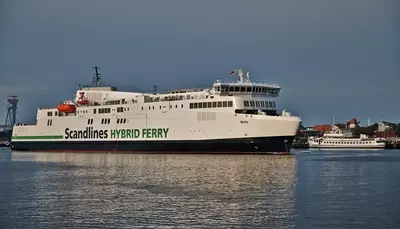 Fähre im Rostocker Hafen
Photo: © Wikimedia / Patrick Kirkby CC BY-SA 3.0
Fähre im Rostocker Hafen
Photo: © Wikimedia / Patrick Kirkby CC BY-SA 3.0
Several routes from Germany and Poland to Denmark and Sweden have become well-established, high-frequency, year-round ferry services. Probably the busiest route is the one from Puttgarden on Fehmarn to Rødby in Denmark. A tunnel is now under construction here, though a future ferry service remains a possibility. Other traditional routes include Rostock-Gedser (Denmark) and Travemünde-Trelleborg. The Polish port of Świnoujście is the departure point for ferry services to Ystad in Sweden. Ferry services between Sweden and Finland are also important to the overall transport networks of both countries. Stockholm and Kapellskär in Sweden, as well as Turku and Helsinki in Finland, are the endpoints of several ferry routes served by vessels among the largest in the world.
Ferries from Germany serve destinations in Scandinavia and the Baltic States. Sassnitz connects Rügen Island with Trelleborg and the Danish island of Bornholm. Rostock is the departure point for ferry crossings to Gedser (Denmark) and Trelleborg. Ferries from Travemünde sail to Trelleborg, Malmö, Helsinki and Liepāja, while Kiel is the port of departure for ferries to Oslo, Gothenburg and Klaipėda (Lithuania).
The Swedish Baltic island of Gotland is connected by ferry to Nynäshamn south of Stockholm, as well as to the port of Oskarshamn . Ferry links between the Baltic States and Finland and Sweden have also taken on renewed importance.
Ferry services account for a substantial share of transport in the Baltic Sea region. For many holidaymakers from central Europe, they are the fastest and most enjoyable way to travel across the Baltic Sea to Scandinavia.
