
Hohenmocker: Discover its church and manor house history
Accommodation in Hohenmocker
Explore Hohenmocker through its architectural history and the historic landmarks in the surrounding municipality. The church and parish widow’s house highlight medieval church architecture and living conditions of the past; Hohenbrünzow and Tentzerow add manor houses, parks and distinctive landscape features to the picture. If you are looking for accommodation for your stay, these different themes can help you decide what interests you.
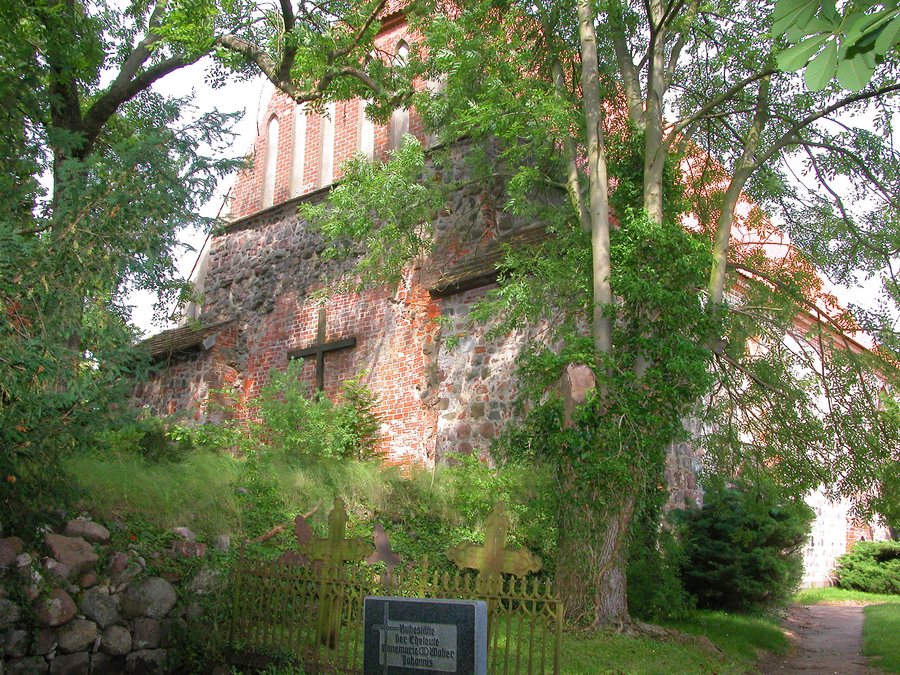 File:20040624560DR Hohenmocker Kirche mit freistehendem Glockenstuhl.jpg
Photo: Jörg Blobelt via Wikimedia Commons, CC BY-SA 4.0
Church: construction date and defensive function
The church in Hohenmocker is an Early Gothic fieldstone ashlar building, constructed around 1235 on a hill. Its first documented mention dates to 1239. These two dates refer to different historical milestones: the approximate construction date and the first written record.
The foundations and traces of the walls of a former transept tower can still be seen on the west side. The tower served as a shelter for the local population. The massive foundations of the lower part of the tower were 3.20 metres thick; such a broad construction is considered rare in the area. In this way, the church combines its Early Gothic architecture with the identifiable former function of the tower.
The parish widow’s house as a record of everyday life
The Hohenmocker parish widow’s house was built around 1800 as a half-timbered building. It comprises two residential units and adjoining stables under one roof. This architectural arrangement illustrates the house’s purpose, while its significance extends beyond its architecture: it shows the former living conditions of the occupants of the parish farm, including servants and parish widows.
The church and parish widow’s house thus tell different sides of the town’s history. The church brings its design, construction date and former defensive function to the fore; the parish widow’s house draws attention to life around the parish farm. Together, they offer two different ways to explore Hohenmocker’s history.
Manor houses and parks in the municipality
Further historic landmarks can be found in the municipality of Hohenmocker, in the named localities of Hohenbrünzow and Tentzerow. Hohenbrünzow Manor House was built around 1865 in the late Neoclassical style; the English landscape garden was laid out around the same time. With its manor house, park and farm buildings, the estate was among the largely intact manor estates in Mecklenburg-Vorpommern until some of its stable buildings were demolished. The manor house is privately owned and has been undergoing restoration since 2018.
Tentzerow Manor House is a remodelled building from the early 19th century and consists of two sections. The manor house park contains an Early German motte dating from the 14th or 15th century, overgrown with mighty pedunculate oaks. There is also a Virginia juniper in the former manor park, just west of the manor house. Tentzerow thus brings together architectural history, an archaeological landscape feature and a remarkable collection of trees.
Landscape and getting around
The Strehlower Bach flows through the area around Hohenmocker and later joins the Augraben at Leistenow Mill. For rail travel, Sternfeld station is a specific landmark: it is located at Bahnhof 34, 17111 Hohenmocker. Check the timetable in advance for your travel dates.
More nature highlights in the Mecklenburg Lake District
The Müritz National Park is a highlight in its own right within the wider Mecklenburg Lake District destination. Its landscape is characterised by forests, marshes, lakes and expansive meadows. The Müritz National Park hiking trail covers the park’s landscape types and special features in nine stages: it runs along lakes, through ancient forests, past inland dunes and to the source of the Havel. Certified nature and landscape guides offer informative tours there, including guided visits to the UNESCO World Heritage beech forest at Serrahn and tours from the water. The hiking trail and guided tours offer different ways to explore the national park’s landscape.
The Damerower Werder bison reserve is also in the Mecklenburg Lake District, on a peninsula in Lake Kölpin and in the Nossentiner/Schwinzer Heath Nature Park. Visitors can observe bison there. The reserve also has a forest adventure trail with climbing opportunities, an ant house, an exhibition featuring tactile and visual panels, and a dendrophone. These nature highlights add to the picture of Hohenmocker without replacing its local architectural and municipal history.
Discover more destinations: Verchen, Warrenzin, Nossendorf, Kentzlin, Meesiger, Sarow, Lindenberg, Sommersdorf.
For the broader travel overview: Amt Demmin-Land.

